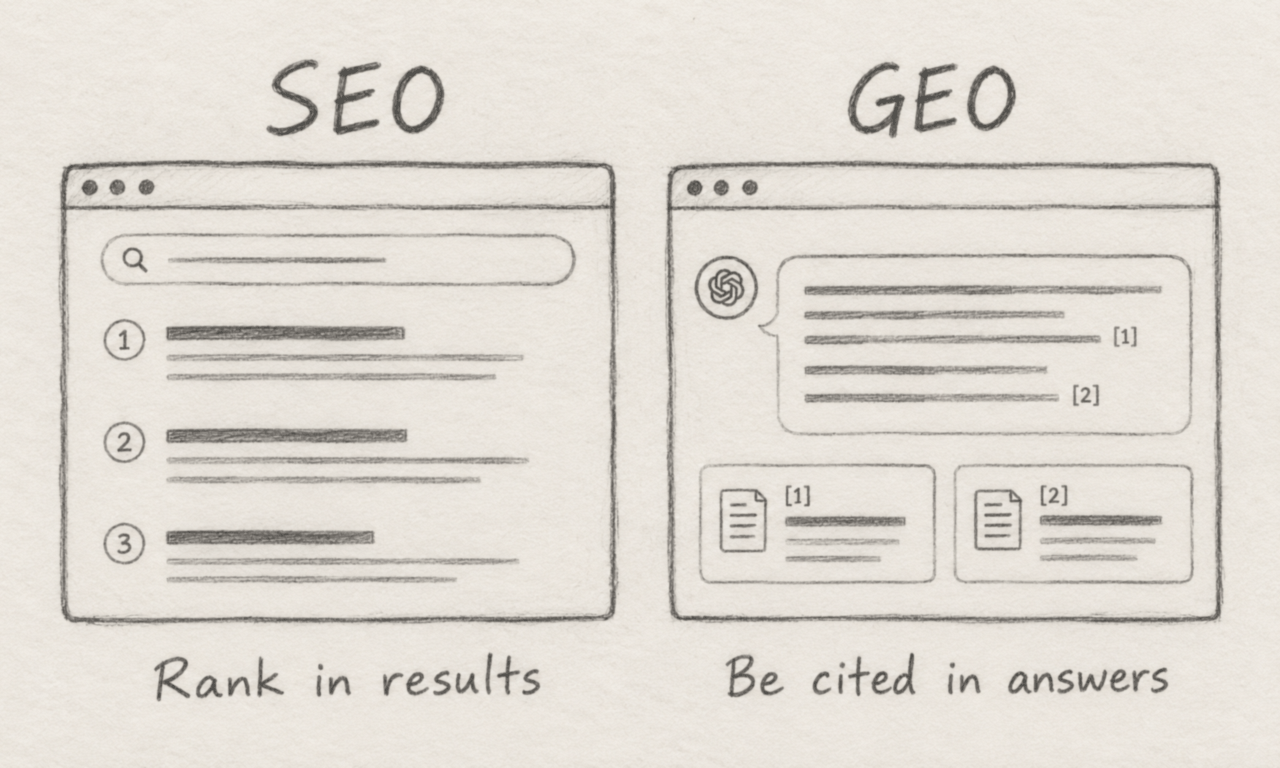
TL;DR
- SEO gets your pages ranked in Google. GEO (generative engine optimization) gets your brand cited inside AI answers from ChatGPT, Perplexity, Gemini and Google's AI Overviews.
- GEO builds on SEO. It doesn't replace it. Strong technical SEO, authority and content quality are the foundation both depend on.
- They still differ in important ways: keywords vs prompts, rankings vs citations, and your own site vs what the rest of the web says about you.
- Measure them differently. SEO tracks rankings and organic traffic. GEO tracks mention rate, citation frequency and share of voice in AI answers.
- For most B2B teams, the answer isn't "SEO or GEO." It's both, in the right order: fix the SEO foundation, then layer GEO onto your most important pages.
Why Trust This Guide
EverClif runs SEO and GEO programs for B2B tech companies. We work on both every week, so we see where the advice overlaps and where it genuinely splits.
We also don't sell an SEO or GEO tool. Most of the articles ranking for this topic end with a pitch for the author's own software. This one doesn't.
How We Compared GEO and SEO
We compared the two on seven dimensions: the goal, what you optimize for, where the work happens, how results are chosen, how success is measured, how often content needs updating, and how long results take.
Where we quote numbers, we name the source: the original GEO research paper, plus studies from Ahrefs, Semrush, Bain and others. Several of these figures reached us through other articles, and we flag that where it applies.
What Are SEO, GEO and AEO?
Three acronyms, and plenty of people using them interchangeably. Here's what each one actually means.
What Is SEO?
Search engine optimization is the work of getting your pages to rank higher in traditional search results on Google and Bing. It runs on keywords, backlinks, technical health and content that matches what searchers want. Success means a higher position, more clicks and more visits.
What Is GEO?
Generative engine optimization is the work of getting your brand mentioned and cited inside AI-generated answers. Instead of ranking a link, you're trying to be one of the sources the AI draws on when it writes its response.
The term comes from a research paper by a team from Princeton University, Georgia Tech, the Allen Institute for AI and IIT Delhi. They tested which content changes made pages more visible in generative engine answers. More on their findings below.
What Is AEO?
Answer engine optimization is the practice of shaping content so it gets pulled into direct answers: featured snippets, People Also Ask boxes, voice results and, more and more, AI responses.
In practice, AEO and GEO overlap heavily. Some people treat AEO as the tactical layer (structuring a clean, quotable answer) and GEO as the broader strategy (earning citations and authority across AI systems). Don't lose sleep over the boundary. Both demand clear, direct, well-sourced answers.
(One quick clarification: "GEO SEO" sometimes means geo-targeting, or local SEO. That's a different topic. In this article, GEO always means generative engine optimization.)
GEO vs SEO vs AEO: Side-by-Side Comparison
Here's how the three compare:
| SEO | GEO | AEO | |
|---|---|---|---|
| Output | A ranked list of links | A written AI answer with a few cited sources | A direct answer (snippet, PAA, voice, AI) |
| Engines | Google, Bing | ChatGPT, Perplexity, Gemini, Claude, AI Overviews | Search features and AI assistants |
| Query format | Short keywords | Long, conversational prompts | Questions |
| What you optimize for | Ranking position | Being cited or mentioned | Being the answer |
| Where the work happens | Mostly your own site | Your site plus third-party sources | Mostly on-page structure |
| Success metrics | Rankings, organic traffic, CTR | Mention rate, citation frequency, share of voice | Snippet and answer wins |
| Update needs | Periodic refreshes | Frequent, since AI favors fresh content | Periodic refreshes |
| Time to impact | Months | Can be faster on strong pages; still building | Weeks to months |
The biggest practical change is in the result itself. A search results page hands the user ten links and lets them choose. An AI answer reads the sources for them, writes a summary and cites a handful. The user may get what they need without ever clicking.
Semrush's study of more than 10 million keywords found AI Overviews appeared on 13.14% of queries in March 2025, up from 6.49% that January. That's roughly double in three months.
Where SEO and GEO Overlap
More than the hype suggests. Both reward:
- Technical health. If a page can't be crawled, neither a search engine nor an AI system can use it.
- Authority. Trusted, well-linked sites tend to do well in both.
- Content quality. Clear, accurate, useful content wins everywhere.
- Structured data. Schema markup helps every engine understand what your content is.
This is why strong SEO is the foundation for GEO, not a separate track.
Where SEO and GEO Diverge
Three differences matter most.
Keywords vs prompts. SEO targets short search terms. GEO has to anticipate long, specific questions, like "What's the best ABM platform for a 50-person SaaS company?"
Rankings vs citations. SEO asks "What position are we in?" GEO asks "Did the AI mention us, and how?"
Your site vs everyone else's. SEO work happens mostly on pages you control. GEO is shaped heavily by what reviews, publications, forums and comparison sites say about you, because AI systems draw on all of it.
How each one decides what to show. Google ranks pages by weighing hundreds of signals: relevance to the query, links from other sites, page experience, freshness and more. The output is an ordered list, and the user picks. An AI engine works differently. It retrieves a set of possible sources, reads them, and writes an answer, citing the few that best support what it's saying. That means it favors passages it can lift cleanly: a crisp definition, a specific number, a well-attributed quote, a clear comparison. A page can be relevant and authoritative and still lose the citation to one that simply states the answer more plainly.
So on the same page, SEO asks "Is this the best result for the query?" GEO asks "Is this the best sentence to quote?"
Why Ranking Well Doesn't Guarantee AI Citations
This is where a lot of SEO-only teams get caught out.
Erlin AI's research, which Upreports summarizes, found that fewer than 10% of the sources cited in ChatGPT, Gemini and Copilot answers rank in Google's top 10 for the same query. StoryChief showed the same pattern in practice: a Perplexity answer citing pages ranked #6 and #10 first, while the #1 result wasn't cited at all.
Ranking and citation are related. They're not the same scoreboard.
GEO vs SEO Metrics: How to Measure Each
Most comparisons skip this part. It's the part your CFO will ask about.
| SEO KPIs | GEO KPIs |
|---|---|
| Keyword rankings | Mention rate: how often AI answers mention your brand for your target prompts |
| Organic traffic | Citation frequency: how often your pages are linked as sources |
| Click-through rate | Share of voice: your mentions vs competitors' in the same answers |
| Organic conversions and pipeline | AI referral traffic and its conversion rate |
Volume vs value. Ahrefs data, as reported by Foundation, shows organic search traffic falling 21% for the average website last year, while traffic referred by AI platforms grew 9.7x. AI still sends far less traffic than Google. But it tends to reach buyers who are further along. A useful way to frame it: SEO is your volume engine, and GEO is increasingly your decision engine.
How a GEO audit differs from an SEO audit. An SEO audit crawls your site and checks rankings. A GEO audit starts from questions. Write down the 20 to 50 prompts your buyers actually ask, run them across ChatGPT, Perplexity, Gemini and Google's AI Overviews, and record who gets mentioned, who gets cited and what's said about you. Repeat monthly. Results vary by platform, so track each one separately. Our guide on how to measure AI search visibility turns that audit into a repeatable prompt log and reporting routine.
Here's what that looks like in practice. Say you sell expense management software to mid-sized companies. Your prompt list might include "best expense management software for a 200-person company," "Expensify alternatives for finance teams" and "how to automate expense approvals." Run each one in ChatGPT, Perplexity, Gemini and AI Overviews. Note whether you're mentioned, whether you're linked, which competitors appear, and what the answer says about you. After one round, you'll usually see a pattern: one or two competitors dominate, and the sources cited are a handful of review sites and comparison articles. Those sources become your GEO target list.
(The first audit is often humbling. That's fine. It's a baseline, not a verdict.)
How to Build a GEO Strategy on Top of SEO
Start with what the research actually tested. The original GEO paper measured how different content changes affected visibility in AI answers. As summarized by Pierview:
- Citing authoritative sources: about +40% visibility
- Adding specific statistics: about +37%
- Including expert quotations: about +22%
- Keyword stuffing: roughly no effect
That last line is the one SEO veterans should sit with for a minute.
Here's how that translates into practice:
- Lead with the answer. Put the core fact or definition in the first one or two sentences of each section. AI systems extract answers, not build-up.
- Back claims with named sources and numbers. This is the biggest single change you can make, and the easiest to start today.
- Describe your brand consistently. Use the same clear description of who you are and what you do across your site, profiles and third-party listings. AI systems build their picture of you from all of it.
- Keep content fresh. Seer Interactive's research (via Upreports) suggests recently refreshed content shows up in AI answers about 4.3 times more often than stale pages.
- Earn third-party mentions. Reviews, analyst coverage, industry publications and expert roundups all feed the sources AI draws on. Digital PR now doubles as a GEO tactic.
- Use schema markup. It helps both search engines and AI systems understand your content.
A quick before and after shows the difference. A typical SEO-era paragraph reads: "Expense management is an important part of running a business, and many companies are looking for better solutions." A GEO-ready version reads: "Expense management software automates receipt capture, approvals and reimbursement. Finance teams typically use it to cut manual processing time and catch policy violations before payment." The second one answers a question in its first sentence, names concrete tasks and gives an AI something specific to quote.
What doesn't carry over: keyword stuffing, thin pages built only to rank, and content that says the same thing as ten other pages without adding a fact, a number or a point of view. If an AI can summarize the topic without you, it will.
Do You Need Both? Where B2B Teams Should Start
Yes. But not in equal measure, and not all at once.
If you need implementation support, compare GEO and AEO agencies by their methods, evidence and measurement approach.
First, ignore the "SEO is dead" takes. AI systems still lean heavily on content that search engines can crawl and trust, and Google remains the largest source of discovery on the web. Cutting SEO to fund GEO is like removing a building's foundation to pay for a nicer roof.
Search Engine Land has argued that "SEO vs GEO" is a false choice, and we agree. The real question isn't which one to pick. It's what to do first.
Here's the order we'd recommend for most B2B teams:
Fix the SEO foundation.
Crawlability, site structure, internal linking and core content. Everything else depends on it.
Layer GEO onto your best pages.
Start with the pages that already rank or convert. Add direct answers, statistics, sources and clear structure.
Start tracking AI visibility.
Build your prompt list and benchmark where you show up today.
Expand your third-party presence.
Reviews, guest expertise, PR and partner content.
Working with a small team or budget? Pick your 10 most important pages and the 20 questions buyers ask most before they talk to sales. Get those right first. That's a quarter's work, not a year's.
And it's still early. Omnibound's research, reported by Upreports, found 92% of marketers plan to optimize for AI search but only 40.6% are actually doing it. That gap won't stay open forever.
Final Thoughts
GEO isn't a replacement for SEO, and it isn't SEO with a new name. It's what happens when the search result stops being a list and starts being an answer.
The teams that win both keep doing the SEO fundamentals and start making their content easy for AI systems to quote: direct, specific, sourced and current.
Rank to be found. Be quotable to be chosen.