TL;DR
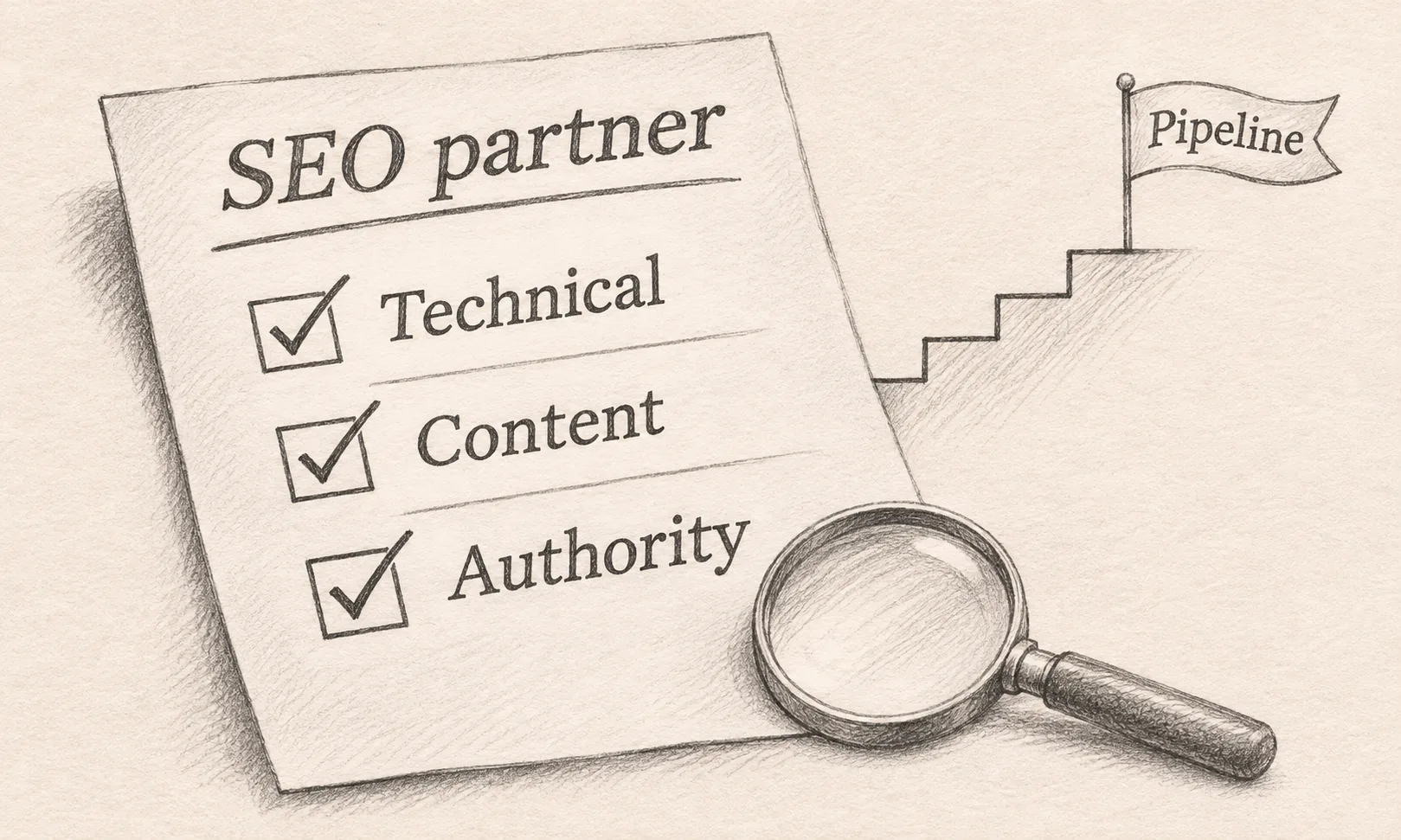
There’s no single best B2B SEO agency. There’s the best one for your sales motion, your budget, and how much your team can actually ship. Logo walls tell you very little about that.
Here’s the short version. EverClif (that’s us) suits B2B SaaS, IT services, and FinTech teams that want SEO, GEO, the website, and reporting owned by one accountable team. Directive fits enterprise tech budgets that want SEO wired into paid media and RevOps. Omniscient Digital and Grow and Convert are content-led. Stratabeat bundles CRO into SEO. Siege Media does content and digital PR at scale. Optimist and RevenueZen publish startup-friendly pricing. iPullRank is who you call for hard technical problems, and First Page Sage runs thought-leadership publishing.
Whoever you shortlist, ask four things before you sign. How do you measure success? (If the answer stops at traffic, keep looking.) Who does the actual work? How many clients does that person carry? And what’s the plan for showing up in AI answers?
A quick disclosure: EverClif publishes this list, and we put ourselves first. Every other agency here is one we’d recommend to a prospect who’s a better fit for them than for us. We’ve tried to be specific about when that is.
What Makes B2B SEO Different
Most SEO advice is written for consumer brands. Big keyword volumes, quick decisions, one person clicking “buy.”
B2B doesn’t work like that. Gartner’s research on B2B buying puts the typical buying group at six to ten decision-makers. Add a months-long evaluation, a security review, and a procurement team that will never read your blog. The person who googles the problem is rarely the person who signs the contract.
So “good SEO” means something else here. The keywords that sit closest to a purchase (comparisons, alternatives, integrations, specific use cases) usually have tiny search volumes. An agency that reports on traffic alone will quietly steer you toward broad, top-of-funnel topics because they make the dashboard look good. They do almost nothing for pipeline.
Then there’s AI search. A growing share of buyers now ask ChatGPT or Perplexity for a vendor shortlist before they ever see a results page. Whether you make that shortlist depends on the same fundamentals as SEO: topical authority, consistent entity signals, third-party mentions, content that’s easy to quote. But it only happens if someone plans for it. That’s why we treat generative engine optimization (GEO) as a core requirement for any B2B SEO agency in 2026, not an upsell.
How We Evaluated These Agencies
We ignored size, awards, and how often an agency shows up in other listicles. None of those predict whether you’ll get pipeline. These did:
- B2B focus: Are the clients, case studies, and positioning actually B2B, or is B2B one vertical on a long list?
- Pipeline accountability: Does the agency report on leads, demos, and revenue, or stop at rankings and sessions?
- AI search: Is there a defined GEO/AEO practice for ChatGPT, Perplexity, Gemini, Claude, and Google AI Overviews?
- Implementation: Can they fix architecture, indexability, and CMS issues themselves, or do you get a PDF of recommendations?
- Content quality: Is content built around real buyer questions and checked by someone who knows the subject?
- Public proof: Named clients, case studies with actual numbers, third-party reviews.
- Pricing and fit: Who can realistically afford them, and how clearly do they explain what you get?
Pricing and positioning come from each agency’s own site and public review profiles as of late 2026. Packages change often. Treat every number as the start of a conversation, not a quote.
Quick Comparison
| Agency | Best For | Core Strength | Typical Starting Investment |
|---|---|---|---|
| EverClif | B2B SaaS, IT services, FinTech | SEO + GEO + website + analytics under one team | Custom; free audit and forecast first |
| Directive | Enterprise B2B tech | SEO combined with paid media and RevOps | Proposal; built for larger budgets |
| Omniscient Digital | Growth-stage to enterprise SaaS | Content-led organic growth | Around $10K/month |
| Stratabeat | SaaS, fintech, cybersecurity | SEO with built-in CRO | From about $8K/month |
| Siege Media | Brands needing content at scale | Content, design, and digital PR | Proposal |
| Optimist | SaaS and tech startups | SEO + AEO with transparent pricing | From about $4K/month |
| iPullRank | Large, technically complex sites | Enterprise technical SEO | Proposal; enterprise-level |
| Grow and Convert | SaaS with clear product-market fit | Bottom-of-funnel content | Around $10K/month |
| RevenueZen | Smaller SaaS and services teams | SEO plus LinkedIn-led demand gen | From about $3K/month |
| First Page Sage | Professional services, enterprise SaaS | Thought-leadership content | Proposal |
The 10 Best B2B SEO Agencies in 2026
1. EverClif
Yes, we put ourselves first. Here’s the case for it.
EverClif is an AI-driven demand generation agency built only for B2B SaaS, IT services, and FinTech. Our founder, Anirban Saha, spent close to two decades building pipeline engines at American Express, Goldman Sachs, Freshworks, Multiplier, and Hiver. We work as an extension of your marketing team, not a vendor that emails a monthly report.
Our SEO program is judged on qualified leads, not rankings. AI workflows (checked by a human) surface about four times more business-relevant search intent than standard keyword research, and the same team handles content, technical fixes, and authority building. We also build the website, set up the martech stack, and run GEO alongside SEO, so you show up in ChatGPT, Claude, Perplexity, and Gemini as well as Google.
The results speak plainly. A US vertical SaaS client launched on a one-month-old website and grew organic users 8.3x the next quarter. A US martech client doubled non-brand organic traffic against 14 direct competitors. PiAxis AI’s co-founder, Swetha Kochar, says results showed up within a couple of months.
- Best for: B2B SaaS, IT services, and FinTech companies, from seed-stage teams launching a site to scale-ups that want SEO, GEO, and analytics run as one program.
- Strengths: founder-led strategy, SEO and GEO under one roof, in-house web development and CRO, quick wins targeted in the first sprint, weekly reporting.
- Where we’re not a fit: local SEO and consumer ecommerce. We stay in B2B tech and FinTech on purpose.
- Pricing: custom, scoped after a free domain audit and growth forecast. No commitment needed.
2. Directive

Directive calls what it does “customer generation,” and the name fits. Based in Irvine, California, with offices in New York and London, it works with B2B SaaS, tech, and cybersecurity companies and folds SEO into paid media, revenue operations, and conversion work. Organic gets measured in the same pipeline model as every other channel.
That’s the appeal and the catch. If you have a big budget and want one partner owning search, paid, and attribution, Directive brings a large team to it. If you only need SEO, you’re paying for scope you won’t use.
Sprinklr and ZoomInfo are on its client list. That should tell you the size of company it’s built for.
Directive has been around since 2013 and reports more than 100 strategists across 420+ brands. Its AI search work is concrete, too: answer mapping, schema, and AI Overview monitoring. For home care software company AxisCare, it reports scheduled demos up 200% year over year within nine months, with AI tools growing from under 4% to 15% of referral traffic. Clutch reviewers rate it 4.8 across 56 reviews. Clutch also lists a minimum project of $250,000 or more, so this isn’t a test-the-waters agency.
The RevOps practice is what we’d point to. If your marketing and sales teams can’t agree on which channel sourced a deal, having the SEO agency also look at how leads move through your CRM can settle a lot of arguments. Its published case studies, like the one for Inscribe, report keyword and domain authority gains.
- Best for: enterprise and upper-mid-market B2B tech with substantial monthly budgets.
- Strengths: CRM-level pipeline reporting, a dedicated GEO offering, years of SaaS experience.
- Where it falls short: no published pricing, and engagements are built for larger budgets.
3. Omniscient Digital

Omniscient Digital’s leadership came from HubSpot and Shopify, and it shows in how they treat content: as a strategic asset, not a publishing quota. The agency is remote-first and focuses on content-led SEO for B2B software, with digital PR and GEO layered on top.
SAP. Adobe. Loom. Hotjar. That’s the kind of company Omniscient usually works with.
Founded in 2019, with its home base in Austin, it works only with B2B software companies. Content is built from interviews with your sales and customer success teams, which is how you end up with articles that sound like your product instead of a summary of page one. The numbers it publishes are pipeline numbers: $3.7 million from organic search for Smartling (a reported 12.8x ROI), $2.94 million for SpotDraft, and SQLs up 215% for 360Learning. Its AI search service tracks which sources get cited and which buyer prompts you show up for.
The useful part for a smaller team is the thinking, not the logos. Topics are picked by whether they bring in buyers, not just readers. One thing to budget for: published figures for full engagements run from around $10,000 a month to $120,000 a year and up.
- Best for: growth-stage and enterprise SaaS that sees content as a long-term bet.
- Strengths: high editorial standards, content tied to revenue, a roster of well-known software brands.
- Where it falls short: engagements are typically quoted from around $10,000 a month. That rules out most early-stage teams.
4. Stratabeat
Most agencies sell CRO separately. Stratabeat, out of Boston, builds it into the core SEO engagement, so the same team works on getting the visit and converting it. It serves B2B SaaS, fintech, cybersecurity, and martech, and caps how many clients each strategist handles. If you want senior attention, that cap matters.
How tight is that cap? Two to four clients per strategist, according to Stratabeat. Most agencies won’t publish that number at all.
The clearest sign you need Stratabeat: your traffic looks fine, but almost nobody converts. Its work is research-led strategy plus content plus CRO, so the fix often starts on pages you already have. Pricing is published in tiers, from around $8,000 a month, with Scale plans at $15,000 to $21,000 and Dominate plans above $22,000. One piece of advice we’d give for any agency, this one included: confirm who will run your account day to day before you sign.
The proof holds up too. It reports a 222% lift in organic leads for fintech client Masttro, and its past clients include Intel, GE, Nasdaq, Freshworks, and AppFolio. One feature B2B teams tend to love is visitor identification, which shows which companies are reading your content even when nobody fills out a form. Clutch reviewers give it a 5.0.
- Best for: mid-market B2B tech that wants SEO and CRO handled together.
- Strengths: pipeline focus, a low strategist-to-client ratio, recognition at the 2026 US Agency Awards.
- Where it falls short: published packages start around $8,000 a month and climb fast for bigger scopes.
5. Siege Media
Siege Media, based in Austin, makes content that earns links on its own. In-house writers and designers produce assets that people actually want to cite. It works with B2B and B2C brands and has added AI search to its content and digital PR work.
Asana, Intuit, Intercom, Nextdoor, Zendesk. Software and consumer brands sit side by side on its client list.
Ross Hudgens founded Siege in 2012, and it made the Inc. 5000 six years running. The case studies are big. Zapier saw monthly organic traffic up 290% and 47,200 AI Overview citations. AI research company Hebbia went from showing up in about 10% of relevant LLM answers to 42%. One thing to notice: Siege mostly reports traffic and traffic value, not pipeline. If your board wants revenue numbers, ask how they’d connect the two. Technical SEO plays a supporting role, too, so a site with structural problems may need a second partner.
The bet Siege makes is that well-designed content earns its own links, so you aren’t relying only on cold outreach to build authority. For a crowded category, we think that’s the right bet. It holds a 4.9 on Clutch across 48 reviews, and projects start at around $5,000.
- Best for: companies in crowded categories that need to build authority and publish at volume.
- Strengths: content design, link earning through digital PR, well-reviewed on Clutch.
- Where it falls short: it isn’t a B2B specialist, and lean founder-led teams may find the model heavier than they need.
6. Optimist
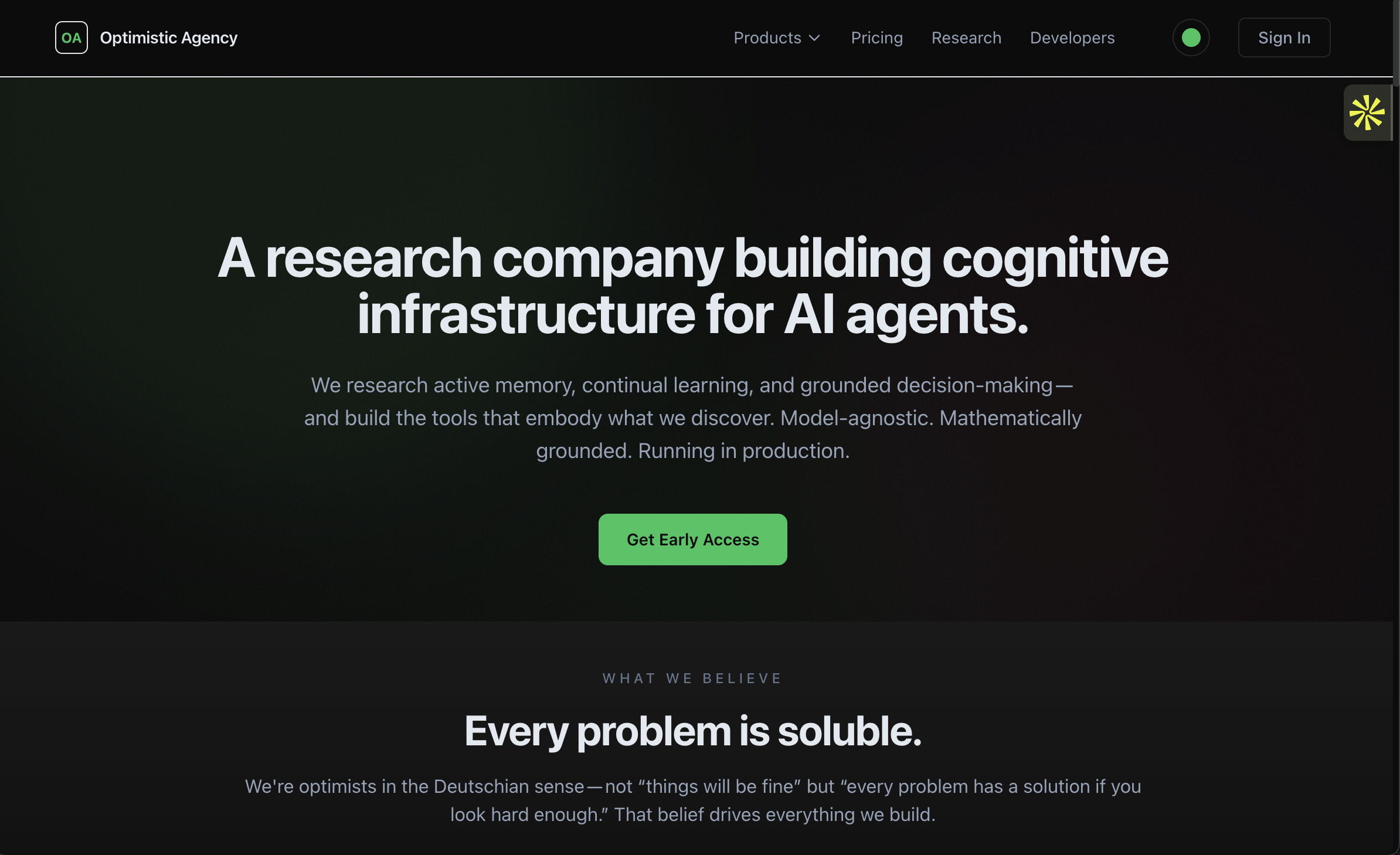
Optimist publishes its prices. In this industry, that alone sets it apart. It does SEO and answer engine optimization for B2B SaaS and tech, offers month-to-month terms, and shares specific numbers in its case studies.
It’s been at this since 2016, as a remote team, and says it has worked with more than 100 B2B tech companies. Two things we like. It calls itself pipeline-first, and AEO is included in the work rather than sold as an add-on. The limit is scope. Optimist stays in B2B tech and isn’t built to run a multi-channel enterprise program.
- Advisory: from around $3,000 a month
- Full service: from around $4,000 a month
- Standalone SEO roadmap: from about $7,500
That’s the whole price list, out in the open. Pair it with month-to-month terms and a client roster that includes Semrush, ZoomInfo, Superhuman, HelloSign, and Stampli, and you get a low-risk way to test an agency before you commit for a year.
- Best for: startup and growth-stage SaaS teams that want transparent pricing and no lock-in.
- Strengths: an established AEO practice, full-service pricing from around $4,000 a month, flexible terms.
- Where it falls short: check how much website and CMS work is included before you sign.
7. iPullRank
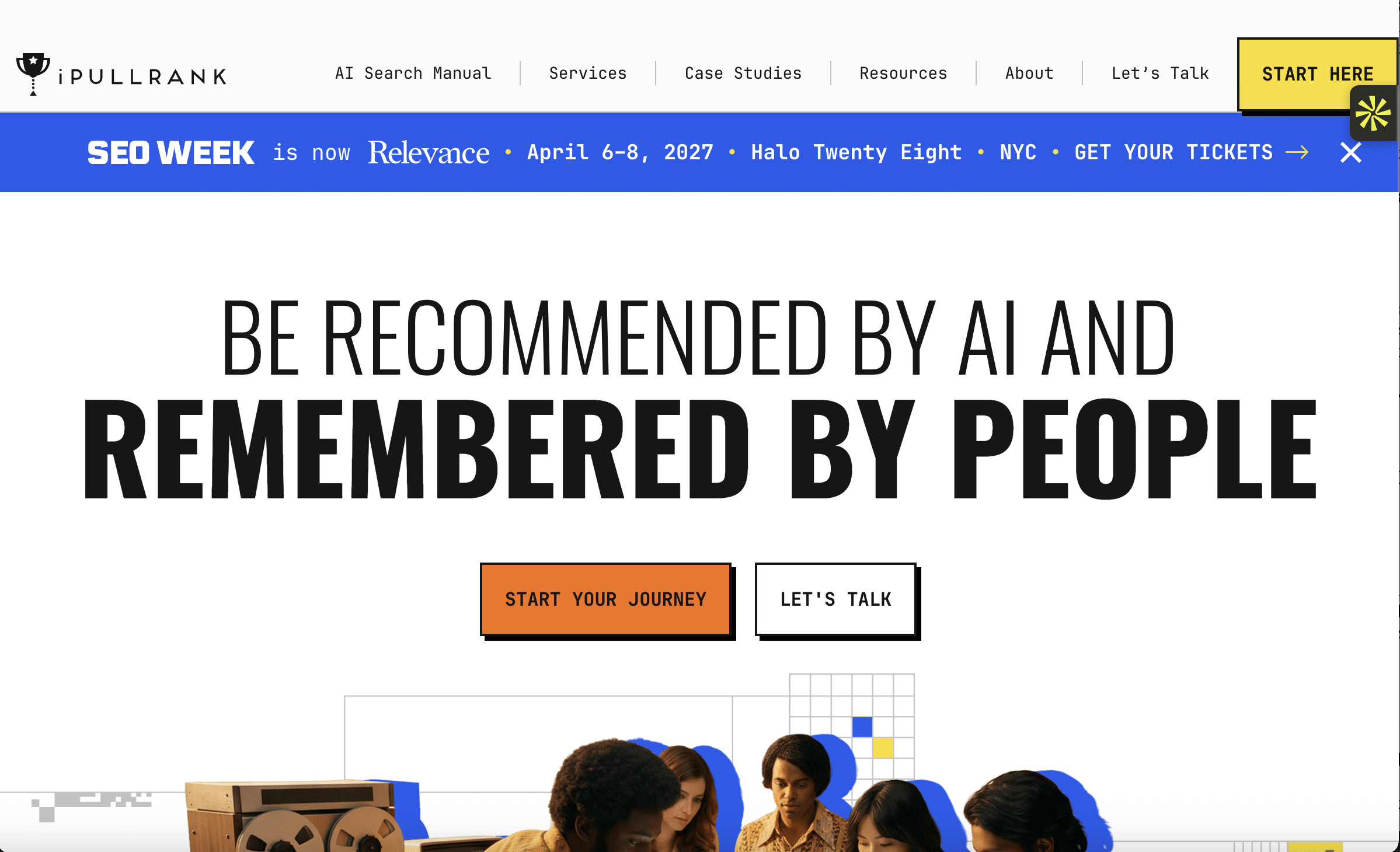
Ask a room of technical SEOs who they’d call for a genuinely hard problem, and iPullRank comes up early. The New York agency handles enterprise-scale technical work like JavaScript rendering, large-site architecture, and advanced measurement. It was also one of the first to write seriously about how AI is changing search retrieval.
Mike King founded it, and he’s one of the best-known speakers on the technical SEO conference circuit. From what the agency publishes, its recommendations are written as much for your engineers as for your marketers.
When is it the right call? When your site runs on a JavaScript framework, has hundreds of thousands of URLs, or keeps losing visibility and nobody on your team can explain why.
Think of iPullRank as the specialist you bring in after a migration goes wrong. Its sweet spot is the stuff most agencies avoid: JavaScript rendering, traffic lost in a botched migration, search engines confusing your brand with another entity, and crawl budget on very large sites. The team is practitioner-led, and you pay a premium for that. What it isn’t built for is a steady, month-after-month content engine. If that’s your main need, look elsewhere on this list.
- Best for: large B2B sites with complex stacks and in-house teams who can act on sophisticated recommendations.
- Strengths: technical expertise few agencies match, thought leadership on AI search.
- Where it falls short: most smaller SaaS companies don’t need this much firepower, and it’s priced for enterprises.
8. Grow and Convert
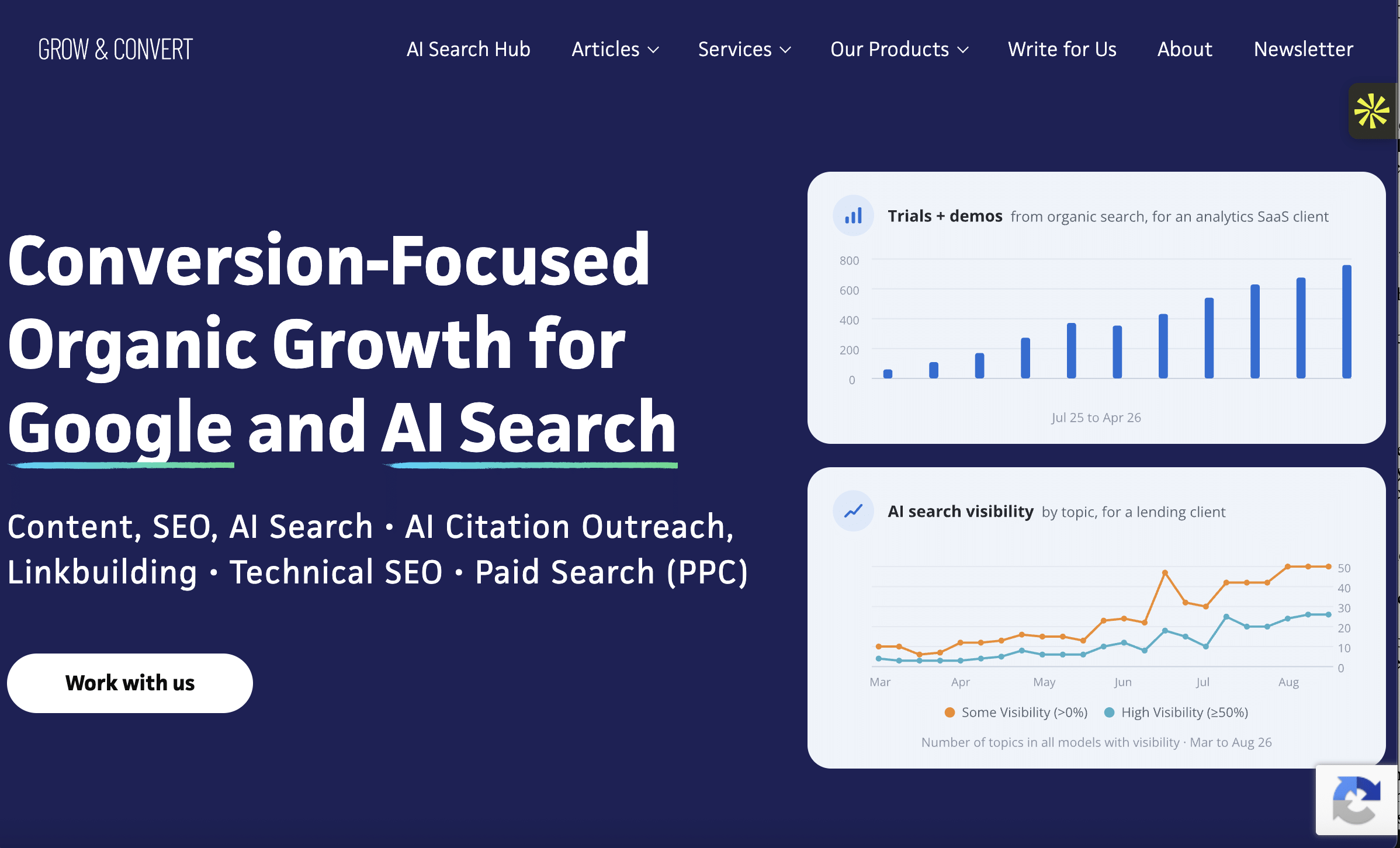
Write for people who are already close to buying. That’s the whole Grow and Convert philosophy. It skips high-volume informational keywords in favor of pain-point and bottom-of-funnel queries, then measures each article by the trials and demos it brings in.
The San Diego agency, founded in 2017, says it coined “pain point SEO.” Its best-known result: for Smartlook, content drove 600+ signups and demo requests a month within 16 months. Each article’s conversions are tracked in a custom analytics dashboard, and the team built its own AI visibility tool, Traqer.ai, to watch citations in AI answers.
Here’s why finance teams like it. You don’t get a pageview report. You get a list of which articles produced signups and demos, so you can see exactly which content earns its keep.
Patreon, ServiceTitan, Leadfeeder, and Pilot have all worked with it. It has also published its own framework for AI search visibility, and it rates 4.8 on Clutch.
- Best for: SaaS companies with product-market fit and a well-defined buyer problem.
- Strengths: buyer-intent keyword strategy, content judged on conversions.
- Where it falls short: it’s a content agency first, so you may need someone else for technical SEO and site work. Content packages usually start around $10,000 a month.
9. RevenueZen
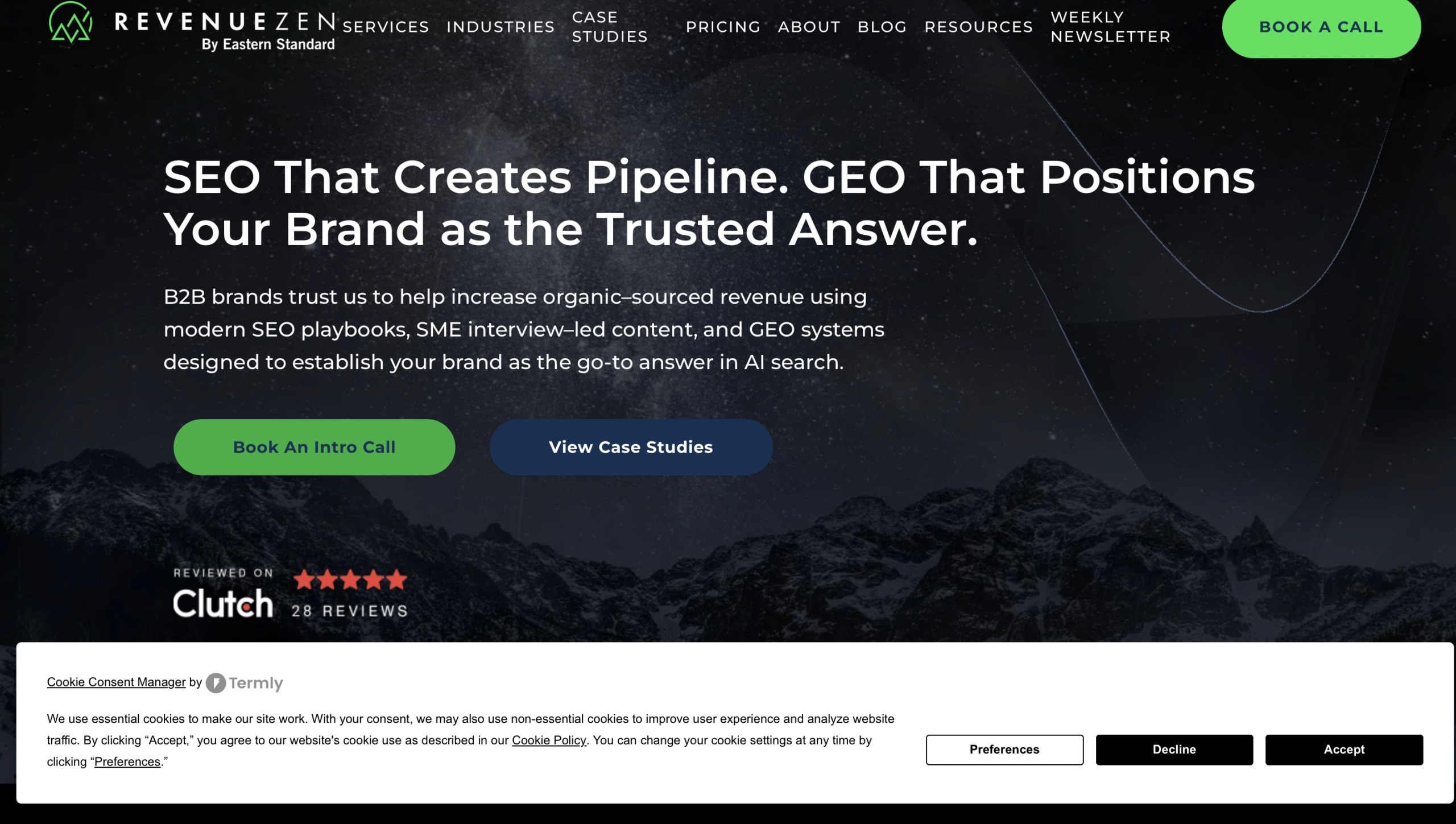
RevenueZen, based in Portland, Oregon, pairs B2B SEO and content with LinkedIn-led demand generation. It’s a good match when the founder’s expertise is the brand. Its published tiers are among the most affordable for a B2B-focused agency.
Start at around $3,000 a month. Grow toward $15,000 as the program proves itself. Few B2B agencies make it that easy to begin small.
The full price list is public: six tiers, from four articles a month at the bottom to original research and AI visibility audits at the top. Link building kicks in from the $7,000 tier. RevenueZen has been running since 2017, rates 4.9 on Clutch across 38 reviews, and reports results in pipeline: $2.2 million from SEO in six months for Pritchard Industries, and qualified leads up 830% in a year for Carevoyance. It’s also honest about timing. It says results usually gain traction around month six.
The LinkedIn angle is the reason to pick it over a pure SEO shop. If your buyers already follow your founder there, an agency that works across search and LinkedIn can make one set of ideas do double duty. RevenueZen lists Expensify and Bizee among the companies it has worked with.
- Best for: early-stage SaaS and professional services firms with founder-led marketing.
- Strengths: content aligned with sales, tiers starting around $3,000 a month.
- Where it falls short: complex enterprise technical SEO isn’t its specialty.
10. First Page Sage
First Page Sage plays the long game with thought-leadership content: a steady flow of expert-level articles meant to earn the trust of high-consideration buyers. Several large enterprise and financial services brands are on its client list, and it publishes plenty of its own research.
Its client roster is full of names you’d recognize: Salesforce, U.S. Bank, Verizon, Microsoft, Logitech. SEO is about 65% of its work, according to its Clutch profile.
It’s been doing B2B SEO since 2009, out of Berkeley, and moved into GEO early, launching the service in May 2023. Its GEO study analyzed more than 11,000 AI queries and was refreshed with 2026 data. On the classic SEO side, it reports a 934% rise in keyword rankings in one year for chip-design software company Cadence. It’s built for high-consideration categories with budgets to match: Clutch lists a $10,000+ minimum project.
Want to know what you’d get? Read what it publishes. Its own research, ranked lists, and benchmark reports are the same thought-leadership style it sells to clients. (It even ranks B2B SEO agencies, just like this post does.)
- Best for: professional services, enterprise SaaS, and other trust-heavy verticals.
- Strengths: consistent long-form content, dedicated content teams for each client.
- Where it falls short: technical and infrastructure issues may need outside help. Pricing is by proposal.
How to Choose the Right B2B SEO Agency
Every agency on this list is good at something. The real question is whether that something is what you need right now.
Start with your bottleneck. If your site has indexing problems or a messy structure after a migration, more content won’t save it. You need technical work first. If the site is healthy but you’re invisible for commercial queries, you need content built around buying intent. Launching from scratch? Then you need someone who can build the site, the structure, and the content plan together. Be honest about which one is you.
Match the agency to your stage. Enterprise-focused agencies often hand smaller accounts to junior staff. Boutiques may not have the bench for a 50,000-page site. Look at the case studies they lead with. Do those companies look like yours?
Decide how much you want done for you. Some agencies write recommendations and expect your team to implement them. Others, including us, own execution: site changes, content, analytics setup. With a small internal team, an advisory-only agency tends to leave you with a long list of good ideas and nobody to do them.
Make AI search part of the plan. A 2026 proposal that doesn’t say how your brand will show up in AI answers is already out of date. You don’t need a second agency for it. You need one that treats it as part of SEO.
Questions to Ask Before You Sign
- How will you measure success at 90 days, six months, and twelve months? Which of those numbers connect to our CRM?
- Who works on our account day to day, and how many other clients do they handle?
- What will you implement yourselves, and what will land on our team?
- Can you show a case study from a company with a similar sales cycle, deal size, and category?
- How will you get us into ChatGPT, Perplexity, Gemini, and Google AI Overviews?
- Who checks content for technical accuracy in our space?
- Can we see a sample reporting dashboard, with client details removed?
- What are the contract terms, and who keeps the content, data, and accounts if we part ways?
Red Flags to Watch For
Guaranteed first-page rankings by a set date. It’s the oldest trick in the industry, and it still shows up in proposals. Google’s own guidance on hiring an SEO is blunt about it: nobody can guarantee a number-one ranking. An agency promising otherwise is inexperienced or planning to cut corners.
Be just as wary of a fixed number of backlinks a month with no word on where they come from.
Watch the reporting, too. If it shows rankings and traffic but never leads or opportunities, the agency isn’t set up to answer for business results. And if the senior strategist from the sales call vanishes after kickoff, you’ll see it in the work within a month. Finally, a long contract with no clean exit puts all the risk on you before the agency has proven anything.
What B2B SEO Costs in 2026
Prices vary a lot, and published numbers often describe very different scopes. Based on what agencies publish today, a rough guide:
- Boutique and startup-focused agencies: about $3,000 to $7,500 a month. Usually strategy, a modest content cadence, and core technical work.
- Specialist mid-market agencies: about $8,000 to $15,000 a month. Bigger content programs, CRO, more senior time.
- Enterprise and integrated agencies: $20,000 a month and up, often bundled with paid media, RevOps, or large-scale content.
The monthly figure matters less than what it buys. Compare deliverables, team seniority, who implements, and how outcomes are measured. A cheap retainer that dumps implementation on your already stretched team can cost more in the end than a pricier one that actually ships.
Final Thoughts
One last test, because it cuts through most sales pitches: ask the agency what they’d stop doing on your site. A team that has looked closely at your business will have a real answer, like pages to cut, topics to drop, or a channel that isn’t pulling its weight. A team that hasn’t will just tell you everything needs more content.
If you’re a B2B SaaS, IT services, or FinTech company and want SEO, GEO, your website, and reporting owned by one team that answers for the outcome, that’s why we built EverClif. Start with a free domain audit and growth forecast. You’ll come away with a clear read on the opportunity, whether we work together or not.
Hire the agency that answers for your pipeline, not just your rankings.