TL;DR
A good B2B demand generation agency gets judged on one number: qualified pipeline in your CRM. Not clicks. Not MQLs. Not a pretty dashboard of impressions.
The shortlist. EverClif (us) suits B2B SaaS, IT services, and FinTech teams that want paid media, SEO, GEO, and analytics run by one accountable team. Refine Labs and Directive are built for bigger SaaS budgets. Kalungi gives you a fractional CMO plus a team. Powered by Search and Obility are long-tenured B2B specialists with strong paid media. Walker Sands combines PR with demand. Understory runs paid, outbound, and LinkedIn as one motion. Ironpaper is an ABM shop for long sales cycles. GrowthSpree is the budget-friendly paid media pick for early SaaS.
Before you sign, ask what number they’ll report every week, who touches your account, and who owns the ad accounts if you leave.
Disclosure: EverClif publishes this list and we put ourselves first. Every other agency here is one we’d point a prospect toward if they were a better fit, and we say when that is.
What B2B Demand Generation Means in 2026
“Demand gen” gets used for almost anything. Lead gen forms, webinars, cold email, LinkedIn ads. So let’s be precise.
Demand generation has two jobs. Demand creation builds familiarity with buyers who aren’t shopping yet. Demand capture converts the ones who are. The split matters because most of your market isn’t buying right now. Research from the Ehrenberg-Bass Institute and the LinkedIn B2B Institute (the “95-5 rule”) estimates that only about 5% of B2B buyers are in-market at any given time. An agency that only does capture is fighting over a small slice. One that only does creation may take a long time to show pipeline.
The buying journey has changed, too. A Gartner survey from March 2026 found 67% of B2B buyers prefer to buy without talking to a sales rep. And G2’s research from April 2026 found 51% of B2B software buyers now start their research in an AI chatbot. Your buyers are doing more homework alone, and a lot of it happens in places your ads can’t reach.
So the best demand gen agencies in 2026 do three things well. They run paid media tied to CRM data, not platform metrics. They build an organic presence (search and AI answers) so buyers find you while researching. And they measure everything in pipeline and revenue.
How We Evaluated These Agencies
We didn’t score on awards, headcount, or social following. These are the things that predict whether an agency will add pipeline:
- Pipeline proof: named clients with real numbers on opportunities, pipeline, or revenue, not just leads.
- B2B depth: whether B2B is the whole business or one segment among many.
- Creation and capture: whether the agency builds future demand as well as harvesting today’s.
- CRM-level measurement: whether offline conversions flow back to ad platforms and reporting lives in the CRM.
- Channel range: paid, organic, AI search, outbound, or ABM, and whether those channels work as one system.
- Pricing and terms: published prices, minimum commitments, and who owns the accounts afterwards.
Facts come from each agency’s own site and public profiles as of late 2026. Most case-study results are self-reported, and prices change often. Use every figure here as a starting point for a conversation, not a quote.
Quick Comparison
| Agency | Best For | Core Strength | Typical Starting Investment |
|---|---|---|---|
| EverClif | B2B SaaS, IT services, FinTech | Paid + SEO + GEO + analytics under one team | Custom; free audit first |
| Refine Labs | SaaS at $50M+ ARR | Demand creation and paid media | From about $14K/month |
| Directive | SaaS and enterprise tech | “Customer Generation” tied to LTV:CAC | Custom |
| Kalungi | SaaS at $5M–$50M ARR | Fractional CMO plus full team | From about $50K/month (full service) |
| Powered by Search | Complex B2B sales cycles | Integrated paid, SEO, and GEO pod | From about $6K/month |
| Walker Sands | Growth-stage and enterprise B2B | PR, brand, and demand together | Custom |
| Obility | B2B tech with real ad budgets | Paid media with first-click-to-close tracking | From about $6.5K/month |
| Understory | Growth-stage B2B SaaS | Paid, outbound, and LinkedIn as one motion | Custom flat retainer |
| Ironpaper | Long, complex sales cycles | ABM and HubSpot | From about $10K/month |
| GrowthSpree | SaaS at $0–$50M ARR | Flat-fee paid media with attribution | $3K/month flat |
The 10 Best B2B Demand Generation Agencies
1. EverClif
Yes, we put ourselves first. Here’s why.
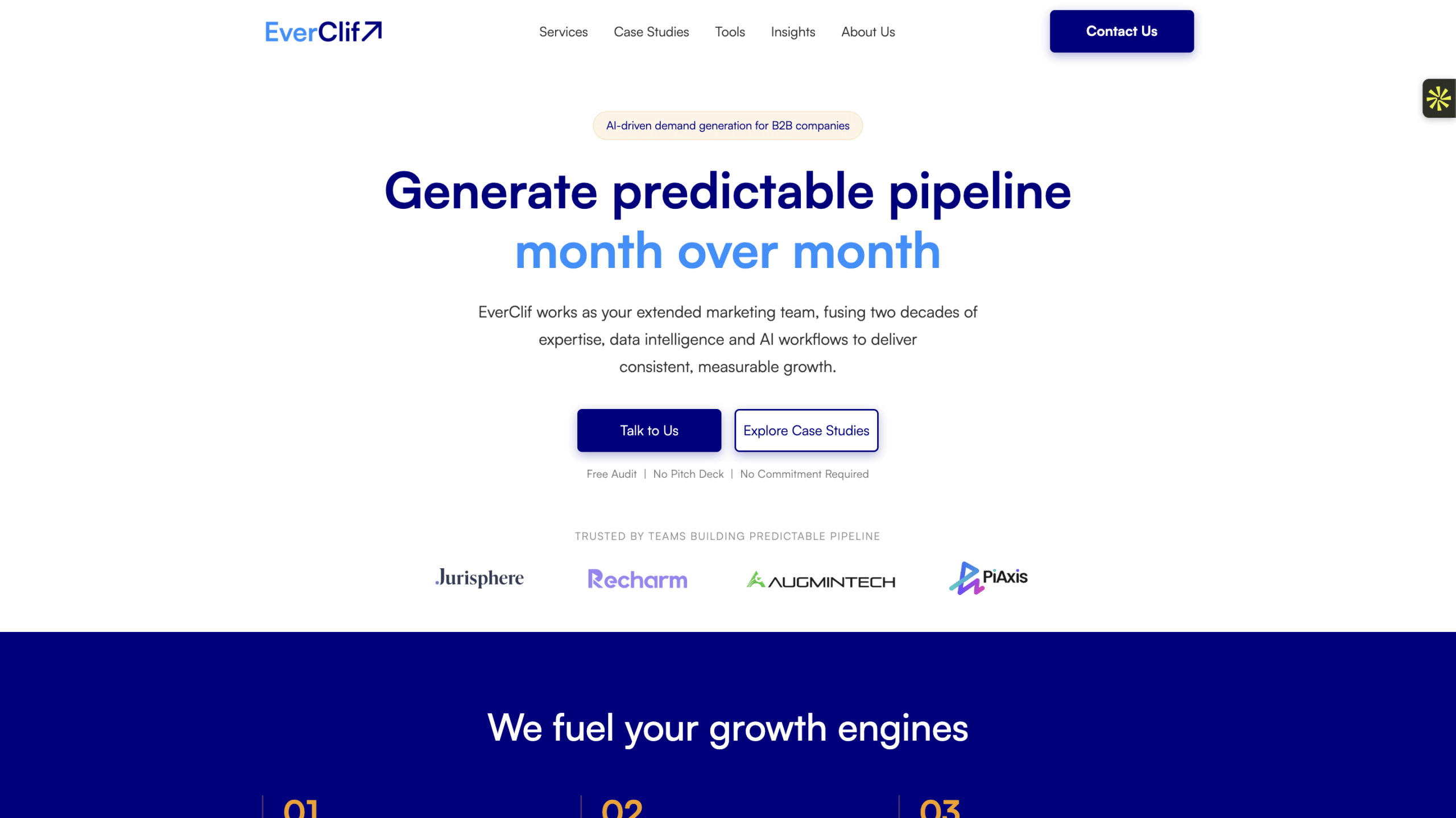
EverClif is an AI-driven demand generation agency built only for B2B SaaS, IT services, and FinTech. Our founder, Anirban Saha, spent close to two decades building pipeline at American Express, Goldman Sachs, Freshworks, Multiplier, and Hiver. We work as an extension of your marketing team, and we win only when you win.
We run both halves of demand gen. Performance marketing across Google, LinkedIn, and Meta captures buyers who are ready. SEO and GEO make sure buyers find you when they research on Google or in ChatGPT. And our analytics practice ties all of it to pipeline. You approve every campaign before a dollar is spent.
The results: for a US AI SaaS company, we fed CRM signals back to the ad platforms. Daily lead rate rose 5.7x, cost per lead fell 48%, and meetings per week rose 48%. A FinTech client in Germany and France grew qualified leads 200% in its first quarter.
- Best for: B2B SaaS, IT services, and FinTech companies that want paid, organic, and analytics run as one program.
- Strengths: founder-led strategy, paid media plus SEO and GEO under one roof, event registration campaigns, in-house web builds.
- Where we’re not a fit: B2C, ecommerce, and local businesses. We stay in B2B tech on purpose.
- Pricing: custom, scoped after a free audit. No commitment needed.
2. Refine Labs
If you’ve heard the phrase “demand creation” on LinkedIn, there’s a good chance it traces back to Refine Labs.
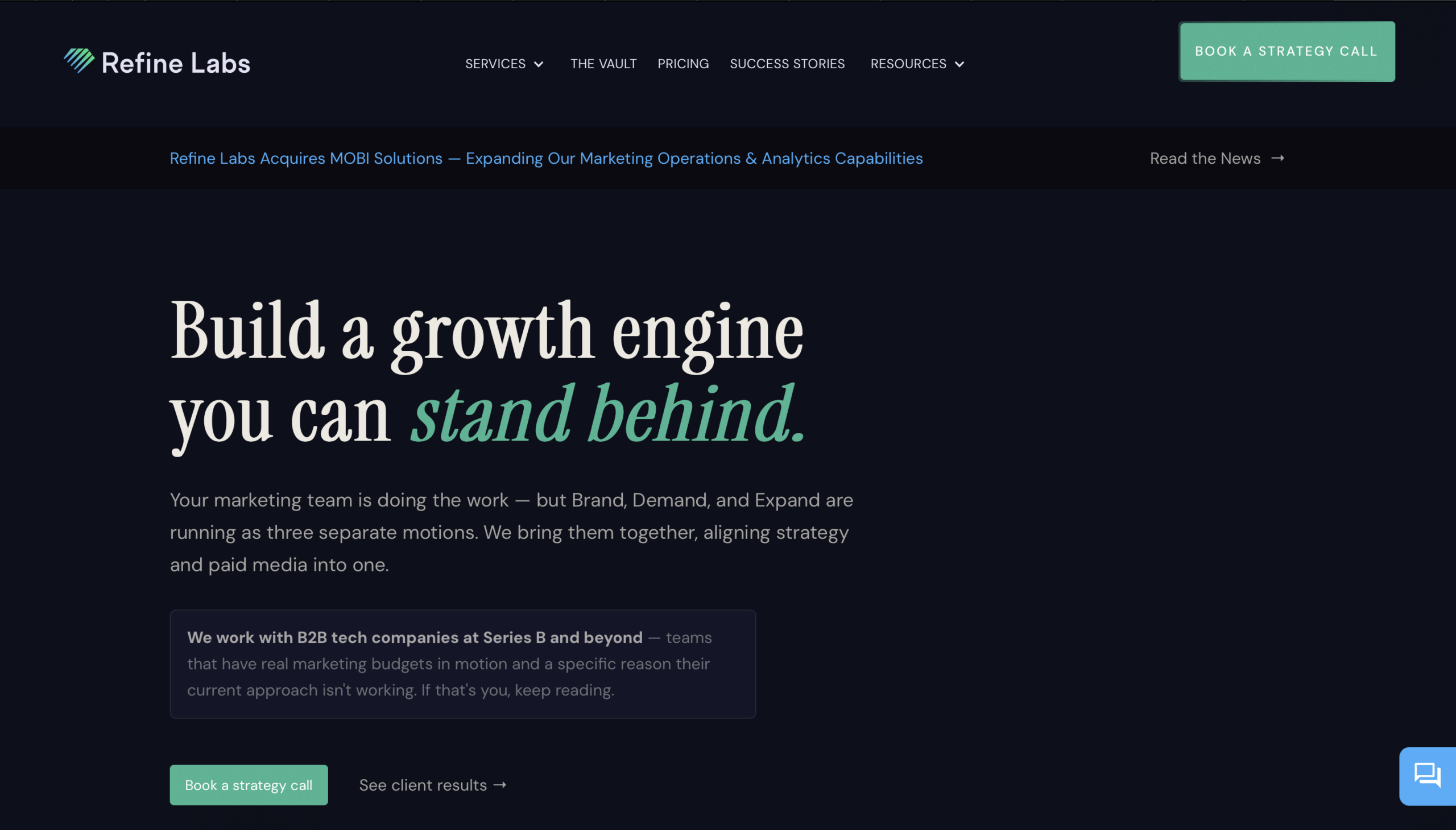
The Boston agency was founded in 2019 by Chris Walker, who made the case loudly that B2B teams should stop gating content and chasing form fills. Walker has since stepped away. Megan Bowen has been CEO since January 2024 and became majority owner in 2025. The thinking still runs through the work, built on a “Brand, Demand, Expand” model and self-reported attribution (asking buyers how they heard about you).
Results are pipeline-grade. Fourth saw 44% more SQLs and a 43% pipeline lift. Firstup grew high-intent pipeline 59% year over year. Vena Solutions saw pipeline velocity rise 745% over a three-year partnership. Clients have also included Clari and Cognism.
The pricing is public, which we respect. Paid media starts around $14,000 a month, full service around $26,000, both with six-month minimums. A six-week assessment starts at $35,000.
- Best for: mid-market and enterprise SaaS, roughly $50M+ ARR.
- Strengths: a clear philosophy, strong paid creative, published pricing.
- Where it falls short: out of reach for most early-stage companies, and there’s no outbound arm.
3. Directive

Directive doesn’t talk about leads. It talks about “Customer Generation,” which means tying ad spend to predicted revenue and LTV:CAC through Salesforce or HubSpot.
Headquartered in Orange County, California, with offices in New York, London, Toronto, and beyond, Directive has been in B2B performance marketing for over a decade and reports 420+ brands served. Since 2025 it has run as three divisions: Performance, Commerce, and Communications. Clients have included Gong, Wiz, Calendly, and Adobe.
A few of its published results: WordPress VIP saw 607% more sales opportunities and 175% more closed-won deals from paid media. Arctic Wolf grew digital revenue 109% quarter over quarter. Swoogo hit an LTV-to-CAC above 3 on every paid channel. Clutch reviewers rate it 4.8 across 56 reviews.
The question to ask is which team you’ll actually get. With a firm this size, the people on the pitch call and the people running your campaigns may not be the same.
- Best for: SaaS and enterprise tech with multi-stakeholder sales cycles and real budgets.
- Strengths: revenue-based measurement, broad channel coverage, RevOps and CRO in-house.
- Where it falls short: no published pricing, and no outbound arm.
4. Kalungi

What if you don’t have a VP of Marketing yet? That’s the gap Kalungi fills.
The Kirkland, Washington agency works only with B2B SaaS and pairs a fractional CMO with a full execution team covering positioning, content, paid media, SEO, ABM, and HubSpot. Its playbook is T2D3, a framework for scaling SaaS revenue in stages. Founded in 2018, it has a new CEO as of March 2026, Antoine Vial, with founder Stijn Hendrikse as chairman.
The case studies are some of the most specific on this list. CPGvision added $4.7 million in pipeline over 16 months. Aware360 cut its sales cycle from six months to 45 days. DataGuard grew MQLs 330% in under six months, and Patch grew them 15x in six months.
The trade-off is price. Full service starts around $50,000 a month. If that’s too much, Kalungi also offers CMO coaching from around $2,500 a month, which can work for a founder running marketing alone.
- Best for: SaaS companies at roughly $5M to $50M ARR without senior marketing leadership.
- Strengths: strategy and execution in one, a SaaS-only focus, detailed published results.
- Where it falls short: some results are reported in MQLs rather than pipeline, and full service is expensive.
5. Powered by Search
Seventeen years in B2B. That’s a long time for an agency to stay focused on one kind of client.
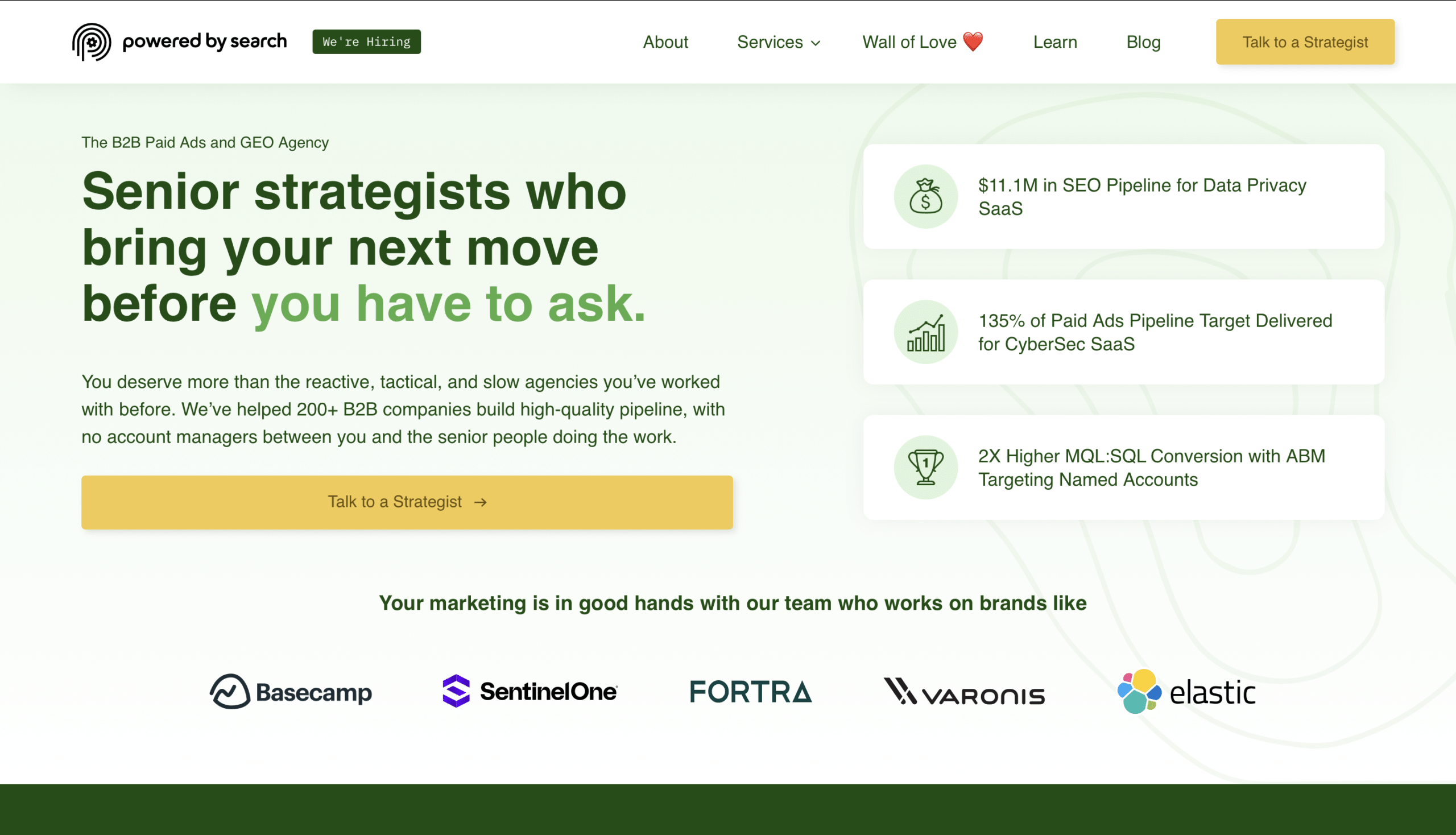
Powered by Search runs an integrated pod of about 40 people covering paid media (Google, LinkedIn, Meta, Bing, YouTube), SEO, GEO, content, and landing pages. CRM conversions are fed back to ad platforms so bidding optimizes for real opportunities. It has worked with 200+ B2B clients in SaaS, cybersecurity, fintech, and healthtech, including SentinelOne, Varonis, Fortra, and Basecamp.
The numbers it publishes: $7.9 million in qualified pipeline for Cyera over 12 months from SEO, 278% year-over-year paid revenue growth for iWave, and 15% SQL growth for Fortra. One detail we like is that you keep ownership of your ad accounts and billing.
Pricing is published: paid media from about $6,000 a month, SEO and GEO from about $9,000. There’s no account director layer. You work directly with the specialists, which is great if you want speed and less so if you want hand-holding.
- Best for: B2B tech with long, multi-stakeholder sales cycles.
- Strengths: paid and organic in one pod, CRM-fed bidding, client-owned accounts.
- Where it falls short: no outbound arm, and no account manager to coordinate for you.
6. Walker Sands
Most demand gen agencies don’t do PR. Walker Sands started with it.
Founded in 2001 in Chicago, with offices in Boston and Seattle, it now combines PR, brand, content, paid media, SEO, GEO, and RevOps under one roof with about 220 people. It has grown by acquisition: KoMarketing in 2023, then RevPartners (a HubSpot and Clay specialist) in June 2026, after Mountaingate Capital took a majority stake in late 2025. Clients include Sophos, Semrush, Paylocity, and John Deere.
Its Sendbird work is a good example of what integrated looks like: 342 influenced opportunities worth $6.4 million, 250 sourced opportunities worth $2.5 million, and 54% more organic traffic.
If earned media and AI citations matter to your category, PR is a real advantage. AI answers lean heavily on trusted third-party sources, and that’s exactly what PR produces.
- Best for: growth-stage and enterprise B2B that wants brand, PR, and demand coordinated.
- Strengths: rare PR plus performance combination, deep bench, new RevOps capability.
- Where it falls short: demand is one capability among many, pricing isn’t published, and the RevPartners integration is still new.
7. Obility
Obility has done B2B, and only B2B, for more than a decade. It’s an execution partner. Don’t hire it to rewrite your positioning. Hire it to run your paid media properly.
Based in Portland, Oregon, it handles paid search, paid social (LinkedIn, Meta, Reddit), SEO, GEO, and RevOps, with attribution from first click to closed deal. Clients have included Puppet, Hitachi, New Relic, and Equinix.
Its Vultr engagement is the standout. As agency of record for three years, Obility cut CAC in half within the first month and by 70% over the engagement, while revenue nearly doubled. On the SEO side, TurnKey Lender generated $8.3 million in pipeline from 89 opportunities.
Pricing starts around $6,500 a month. Obility is upfront that clients spending under about $30,000 a month on ads may not see full returns, which is an honest thing for an agency to say.
- Best for: B2B tech and SaaS with meaningful ad budgets.
- Strengths: paid media depth, full-funnel attribution, 4.8 on Clutch across 27 reviews.
- Where it falls short: not a strategy or brand partner, and smaller ad budgets won’t get the most out of it.
8. Understory
Understory’s idea is “allbound”: one ideal customer profile and one data layer running across paid ads, outbound email, and LinkedIn content at the same time.
The Miami agency was founded in 2021 by Alex Fine and Ali Yildirim and has grown fast. It landed at No. 140 on the 2026 Inc. 5000. Its outbound is built on Clay, and it was among the first five certified Clay Experts. Clients have included Clay, Zapier, and Expensify.
Two results stand out. For Doppel, Google ads influenced $3.65 million in pipeline on about $504,000 of spend. For FullPAC, outbound produced nearly $10 million in pipeline on under $60,000. Launch times are short, too: paid media in one to two weeks, LinkedIn in two to three, cold email in three to four.
It charges flat retainers per service, never a percentage of ad spend. That keeps its incentives tied to pipeline, not to how much you spend.
- Best for: growth-stage and enterprise B2B SaaS with product-market fit and an existing sales motion.
- Strengths: outbound and paid working together, Clay expertise, flat-fee pricing.
- Where it falls short: not for pre-PMF companies, and SEO isn’t a core service.
9. Ironpaper
Selling into a buying committee over a 12-month cycle? Ironpaper has been doing exactly that kind of work for over two decades.
The New York agency has about 70 people and is a HubSpot Diamond partner. Its focus is ABM, content and thought leadership, marketing automation, and sales enablement for complex B2B sales. It doesn’t do cold outbound. Clients have included Steelcase, Mobilewalla, and Goddard Technologies.
For Goddard, it reports more than $3.5 million in influenced opportunities within six months. Other published cases include a telecom management company with a 716% quarter-over-quarter increase in qualified leads.
Retainers start around $10,000 a month. Ironpaper fits sales-led companies, not product-led ones. If you sell through free trials and self-serve signups, its model won’t match how your buyers move.
- Best for: B2B companies with long, high-value, committee-driven sales cycles, especially on HubSpot.
- Strengths: ABM depth, HubSpot expertise, sales enablement.
- Where it falls short: many results are reported as MQLs, and it’s a poor fit for PLG.
10. GrowthSpree

$3,000 a month. Flat. No percentage of ad spend, no long-term contract. That’s GrowthSpree’s pitch, and for an early-stage SaaS company it’s a compelling one.
It runs Google, LinkedIn, and Meta ads for B2B SaaS and connects them to HubSpot, GA4, and Search Console, writing click IDs into the CRM when each lead is created. That makes multi-touch attribution possible even on a small budget. ABM work includes visitor de-anonymization and intent signals. It reports managing more than $60 million in B2B SaaS ad spend across 300+ brands.
Results it cites: Rocketlane reached 3.4x ROAS with cost per demo down 36%. PriceLabs went from 0.7x to 2.5x ROAS on about $100,000 of spend. Trackxi got four times the trial signups at 51% lower cost. Reviewers rate it 4.9 on G2 across 48 reviews.
- Best for: growth-stage B2B SaaS, roughly $0 to $50M ARR, that needs paid media done properly without a big retainer.
- Strengths: transparent flat pricing, attribution baked in, month-to-month terms.
- Where it falls short: paid media only, so you’ll need others for SEO, content, and brand.
How to Choose the Right Demand Gen Agency
Every agency here is good at something. Pick the one whose strength matches your bottleneck.
For a partner focused on organic discovery, content and lifecycle nurture, our comparison of inbound marketing agencies offers a more specific shortlist.
Know your sales motion. Product-led companies need agencies that understand trials, activation, and payback periods. Sales-led companies with buying committees need ABM, nurture, and sales alignment. An agency built for one will struggle with the other.
Decide between one partner or several. A paid-only shop can be excellent at paid, but someone still has to run SEO, content, and AI search. If your team is small, coordinating three agencies becomes a job in itself. That’s the case for an integrated partner.
Be honest about budget. Several agencies here say openly that small ad budgets won’t get full value. Retainer plus ad spend is your real cost. If you can only afford one of the two, the retainer usually isn’t the one to cut.
Plan for the time it takes. Paid media can show signal in weeks, but most agencies expect around 90 days before results are meaningful. Organic and demand creation take longer. Judge an agency on the agreed milestones, not on week three.
Questions to Ask Before You Sign
- What’s the one number you’ll report every week, and does it come from our CRM?
- How do offline conversions get back to the ad platforms, and how often?
- Who works on our account day to day, and how many other accounts do they run?
- Who creates the ads, content, and landing pages, and is that in the retainer?
- Who owns the ad accounts, analytics, audiences, and creative if we part ways?
- What does success look like at 30, 90, and 180 days?
- Can you show a named case study from a company with our sales motion and deal size?
- What’s the minimum term, and what does exiting look like?
Red Flags to Watch For
Fees that grow with your ad spend. A percentage-of-spend model rewards the agency for spending more, not for spending well. It isn’t always a dealbreaker, but ask how they guard against it.
MQL dashboards presented as results. MQLs are an input. If the reporting never mentions opportunities or pipeline, the agency isn’t measuring what you care about.
Anonymous case studies. “A leading SaaS company” could be anyone. Named clients with real numbers are what count.
A pitch that never mentions your CRM. Demand gen that doesn’t connect to your CRM can’t tell you which campaigns actually produce revenue.
And ROAS promises made before they know your LTV. Any agency that guarantees returns without understanding your unit economics is guessing.
What Demand Gen Agencies Cost in 2026
Based on what agencies publish, retainers fall into rough bands (ad spend is separate):
- Entry and specialist retainers: about $1,500 to $5,000 a month, usually one or two channels.
- Mid-market programs: about $5,000 to $15,000 a month, typically multi-channel with CRM reporting.
- Full-service and enterprise: $15,000 to $50,000+ a month, sometimes with fractional leadership included.
- One-time audits or strategy sprints: roughly $10,000 to $35,000.
Compare scope, not sticker price. A $6,000 retainer that excludes creative and landing pages can cost more in practice than a $10,000 one that includes them.
Final Thoughts
Here’s a test worth running on every agency you talk to. Ask them what they’d turn off. Which campaign, channel, or audience would they stop funding after looking at your data? A team that has studied your business will have a specific answer. A team that hasn’t will tell you to spend more.
If you’re a B2B SaaS, IT services, or FinTech company and want paid media, SEO, GEO, and analytics owned by one team that answers for pipeline, that’s what we built EverClif to do. Start with a free audit. You’ll get a clear read on where your pipeline is leaking, whether we work together or not.
Hire the agency that reports pipeline, not activity.