TL;DR
ChatGPT SEO means getting your brand named, cited and recommended when buyers ask ChatGPT the questions you should be answering. It's part of generative engine optimisation (GEO). Most of it is still good SEO. A few things are different, though, and they change what you should fix first.
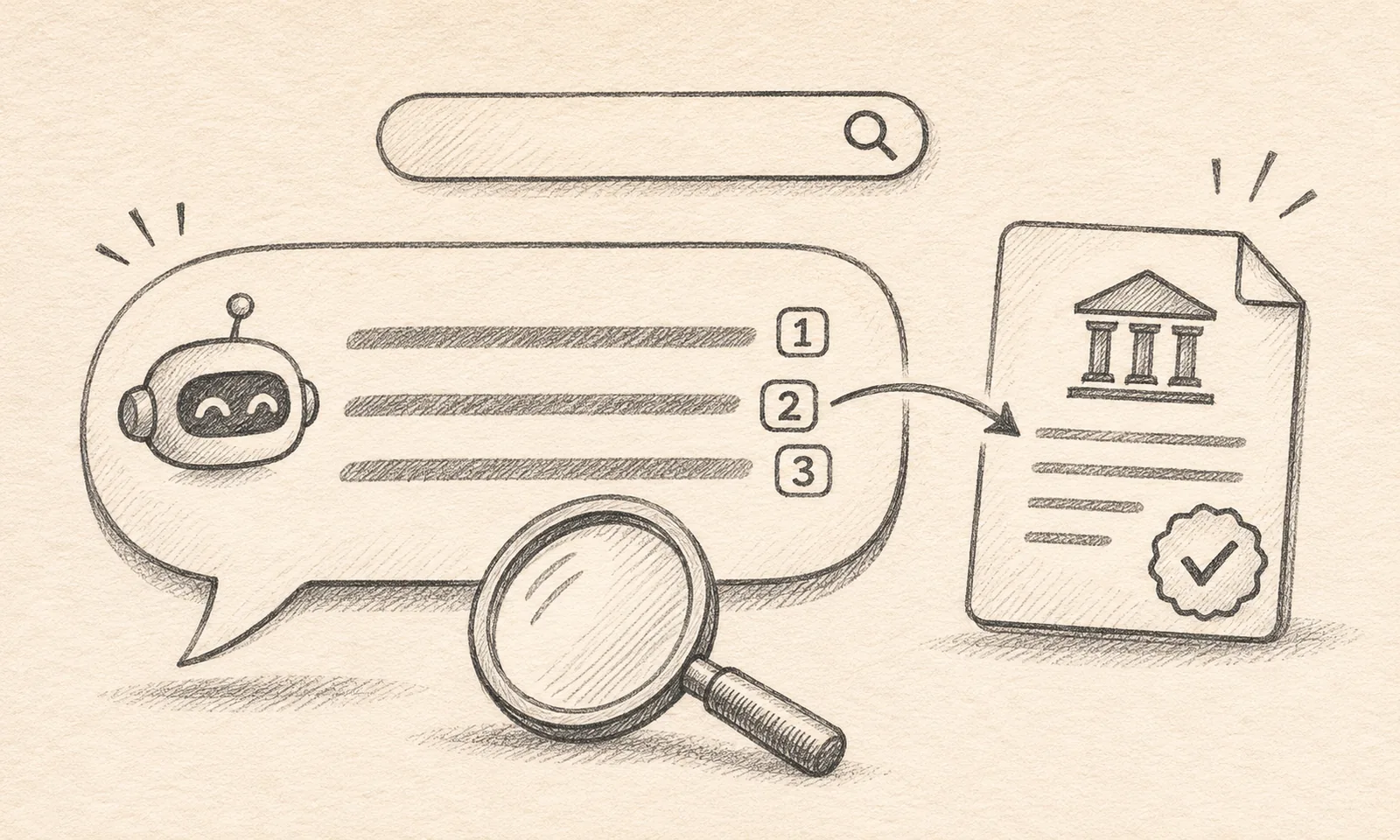
For most questions about current products and vendors, ChatGPT searches the web, rewrites the prompt into several queries, and cites what it retrieves. So your pages need three things. OpenAI's search crawler (OAI-SearchBot) has to be able to reach them. They have to be indexed in the search sources ChatGPT uses, Bing among them. And one passage on the page has to answer the buyer's question by itself. After that, the rest of the web has to agree with you. Review sites, comparison articles, communities and press should describe you the way you describe yourself.
Start with 20–50 prompts your buyers actually use. Check where you stand today. Fix crawler access and Bing indexing. Rewrite your commercial pages answer-first. Earn mentions on the pages ChatGPT already cites. Re-test the same prompts every month. Nobody can guarantee a spot in the answer. OpenAI says so itself. You can still shift the odds a long way.
What Is ChatGPT SEO?
People use the phrase for two different things.
- Optimising for ChatGPT. Making your site and your brand easy for ChatGPT to find, understand, trust and cite. This is what people mean when they search “how to rank in ChatGPT” or “how to get cited by ChatGPT”, and it's what most of this guide covers.
- Using ChatGPT to do SEO. Keyword clustering, briefs, meta descriptions, schema drafts. Useful, and covered briefly further down. But that's about saving time. It won't get you mentioned.
You'll also see the first meaning called GEO, AEO (answer engine optimisation) or LLM SEO. They overlap heavily. GEO is the umbrella across ChatGPT, Perplexity, Gemini, Claude and Google's AI features. ChatGPT SEO is the slice of it that targets the platform most of your buyers are using. Our GEO vs SEO guide explains how the disciplines fit together, and how to optimise for AI search covers the fundamentals that apply to every engine. This post stays specific to ChatGPT.
Why ChatGPT SEO Matters for B2B
Start with the numbers. OpenAI reported more than 900 million weekly ChatGPT users in February 2026. And a lot of that use is research. OpenAI analysed 1.5 million conversations and published the results in September 2025: about half of all messages were people asking for information or advice.
For a B2B company, the questions that matter look like this: “best SOC 2 compliance software for a 50-person startup”, “alternatives to [your competitor]”, “how do I automate vendor onboarding”. ChatGPT answers those with a short list of names and a few links. Miss the list and you miss the deal. Your analytics won't even show you what happened.
Clicks are also getting scarcer when an AI answer is present. Pew Research found that Google users clicked a traditional result in 8% of visits when an AI summary appeared, compared with 15% when it didn't. That study looked at Google. ChatGPT works the same way, only more so. The answer does most of the work, so being named inside it is what counts.
And ranking on Google doesn't carry over by itself. We learned this the uncomfortable way. When we measured our own site in October 2026, we had zero ChatGPT citations. Our only AI citations were six in Microsoft Copilot. A competitor with a longer publishing history and far more third-party mentions had hundreds of AI citations across platforms. We wrote up the full numbers in our AI search visibility guide. The lesson for us: ChatGPT looks well beyond your own domain before it names anyone.
How ChatGPT Decides What to Show
ChatGPT draws on two sources, and each needs different work.
What the model already knows. Its training data gives it a general picture of your category and the brands in it. You can't edit that directly. You influence it slowly, by being described consistently and often across the web, so that future training runs pick up an accurate picture.
What it finds when it searches. For questions that benefit from current information, ChatGPT searches the web on its own. According to OpenAI's help documentation, it rewrites the prompt into one or more targeted queries, sends them to search partners, and builds an answer with inline citations from what comes back. OpenAI's enterprise documentation names Bing as one of those providers. OpenAI also runs its own crawler, OAI-SearchBot, to surface sites in search answers.
That second path is where most ChatGPT SEO happens, and it explains the whole playbook:
- ChatGPT doesn't search the prompt word for word. It splits it into narrower queries. You want a page for each of those sub-questions. One long post that touches everything lightly won't match any of them well.
- It has to reach the page. Block OAI-SearchBot, or miss the index ChatGPT queries, and quality never comes into it.
- It quotes passages, not pages. A paragraph that answers a question cleanly, with your name and the specifics in it, is far easier to cite than the same information spread across three sections.
- It cross-checks. A vendor that five independent sources describe the same way is a safer pick than one only its own website vouches for.
OpenAI doesn't publish its ranking factors. It says only that results are ranked on several factors aimed at reliable, relevant information, and that placement isn't guaranteed. There's no submission form, and no way to pay your way into the organic answer.
ChatGPT SEO vs Google SEO
Same foundations. Crawlable, fast, well-structured pages written by people who know the subject do well in both. What changes is what gets rewarded, and how you find out.
| Google SEO | ChatGPT SEO | |
|---|---|---|
| Goal | Rank a page in the results | Get named, cited and recommended in an answer |
| Unit of competition | The page | The passage, and your brand as an entity |
| Crawler that matters | Googlebot | OAI-SearchBot, plus the search partners ChatGPT queries (Bing among them) |
| Biggest off-site signal | Backlinks | Consistent mentions on sources ChatGPT trusts, linked or not |
| Results are | Fairly stable for a query | Variable; the same prompt can return different brands |
| Measurement | Search Console, rank trackers | Prompt panels, AI referral traffic, self-reported attribution |
So don't stop doing SEO. Add the ChatGPT work on top of it. One content programme can serve both.
How to Rank in ChatGPT: 9 Steps
Do these roughly in order. Teams tend to skip the first three. Skip them and nothing after them gets a fair shot.
1. Start With Your Buyers' Prompts
Keywords still help. But people talk to ChatGPT in questions. Build a list of 20–50 prompts a buyer would type before choosing a product like yours. Pull them from sales-call recordings, demo-request forms, support tickets and the comparisons your reps hear most. Mix four types:
- Category: “best expense management software for startups”
- Problem: “how do I stop employees missing receipt deadlines”
- Comparison: “[competitor] vs [competitor] for a 200-person company”
- Branded: “does [your product] integrate with NetSuite”
Run each one in a fresh, logged-out ChatGPT session, a few times each, and record who gets named and which URLs get cited. That's your baseline. It also tells you which sources you're up against for each prompt. Our guide to building a prompt set has a template.
2. Let OAI-SearchBot In
OpenAI runs three crawlers. People mix them up all the time.
- OAI-SearchBot surfaces sites in ChatGPT search. OpenAI's crawler documentation is direct about it: sites that opt out won't be shown in ChatGPT search answers. This is the one to allow.
- GPTBot collects content that may be used to train OpenAI's models. Blocking it is a training decision, separate from search visibility. Many B2B companies choose to allow it so the model's background knowledge of their brand stays accurate, but that's a call for you and your legal team.
- ChatGPT-User fetches a page when a user's request needs it. OpenAI says it isn't used to decide whether content can appear in search.
Check robots.txt first. Then check your CDN and firewall. Bot-protection rules on Cloudflare and similar services can block AI crawlers even when robots.txt allows them. Nobody notices, because the site still loads fine for people. After a fix, OpenAI says changes take roughly 24 hours to reach search.
3. Get Your Pages Into Bing
If your key pages aren't in Bing's index, ChatGPT can't retrieve them through Bing. And plenty of B2B teams have never logged in to Bing Webmaster Tools. Set it up (you can import from Search Console), submit your sitemap, and check that your product, comparison and pricing pages are actually indexed. Fix crawl errors there the same way you would for Google, and switch on IndexNow if your CMS supports it so updates get picked up faster.
Getting cited in Microsoft Copilot but not ChatGPT? That was us. It means Bing has your pages. The gap is somewhere else, usually your third-party presence or how the pages are written.
4. Describe Your Company the Same Way Everywhere
Before ChatGPT can recommend you, it has to work out what you are. If your homepage says “revenue intelligence platform”, your G2 profile says “sales analytics tool”, and your LinkedIn says “AI for sales teams”, you've given it three weak signals instead of one strong one.
Write one positioning statement: what you are, who it's for, what it does, and where it doesn't fit. Use it on your homepage, about page, Organization schema, LinkedIn, Crunchbase, G2, Capterra, partner directories and press boilerplate. Then go looking for old descriptions. You'll find some. Old pricing, a product you retired, a category you've left. If that's what most of the web still says, ChatGPT will repeat it.
5. Write Passages ChatGPT Can Lift
ChatGPT quotes passages. So each important passage should make sense by itself.
- Use the buyer's question, or something close to it, as the heading.
- Answer in the first two or three sentences (roughly 40–80 words), then add detail, evidence and caveats underneath.
- Name things. “Our platform” can't be cited out of context. “[Product] connects to Salesforce, HubSpot and Pipedrive” can.
- Say what you're not for. “Built for teams of 20–500; not suited to enterprise procurement workflows” is more likely to be trusted, and quoted, than “for businesses of all sizes.”
- Use tables for comparisons and numbered lists for steps. They're easy to extract and easy to verify.
Schema markup (Organization, Product or SoftwareApplication, FAQ, Article) helps machines read the page, as long as it matches what's on it. It makes a good page easier to read. It won't make a thin page good.
6. Build the Pages Buyers Ask About
The prompts that turn into pipeline are commercial ones: comparisons, alternatives, “best X for Y”, pricing, integrations, use cases, security. Most B2B sites we look at have the opposite. Dozens of top-of-funnel explainers, and hardly any of these pages.
Prioritise, in this order:
- “[Competitor] alternatives” and “[you] vs [competitor]” pages that admit where each option fits better
- Use-case and industry pages that match the “for Y” part of buyer prompts
- Integration pages, one per major integration
- A pricing page that gives real numbers or at least real ranges
- Security, compliance and implementation pages that answer procurement questions
Link them into topic clusters. ChatGPT can only retrieve what the search index has, and internal linking still decides what gets crawled and how relevant each page looks. If you're a SaaS company, our guide to B2B SaaS SEO goes deeper on this page set.
7. Get Mentioned Where ChatGPT Looks
Run a few “best X” prompts and look at the sources. Most of them won't be vendor sites. You'll see listicles, review platforms, Reddit threads, analyst write-ups. Your own domain can't win those prompts by itself.
Go back to your baseline from step 1 and list every third-party URL ChatGPT cited. That list is your outreach plan. For each one, ask: are we on it? Is our description accurate? Can we get added, corrected or reviewed? Beyond that, the usual suspects for B2B are G2, Capterra and TrustRadius reviews, industry roundups, partner marketplaces, podcasts, and active, honest participation in the communities your buyers use. Mentions without a link still count. ChatGPT reads the words on the page.
About Reddit. Seeded posts and fake reviews get caught, by moderators first and buyers soon after. Then they sit there, damaging the trust you were trying to build. Post as yourself or don't post.
8. Publish Something Only You Can Say
If your page says what ten other pages say, why would ChatGPT pick yours? Give it a number nobody else has, and it has a reason.
Most B2B companies already have this data: anonymised benchmarks from product usage, survey results from your customer base, pricing data, implementation timelines, failure rates. Publish it with a clear method, a date and a named author. Original data is also the content most likely to earn the third-party mentions from step 7, because other writers cite it too.
9. Keep Key Pages Current
Pricing, “best tools in 2026”, feature comparisons: anything with a shelf life goes stale fast, and a stale page is a weak source. Review your commercial and comparison pages at least quarterly. Change the facts, then the date. Bumping the timestamp on an unchanged page fools nobody for long, and readers who notice stop trusting it.
How to Get Cited by ChatGPT
Three different outcomes get lumped together here:
- Mentioned: your brand name appears in the answer.
- Cited: one of your URLs appears as a source link.
- Recommended: ChatGPT suggests you as an option for the buyer's situation.
Recommendations bring pipeline. Citations bring clicks. A brand can be recommended on the strength of third-party pages without its own site being cited at all, and a blog post can be cited for a definition without the brand ever being recommended.
To earn citations to your own pages specifically:
- Be the primary source. If a statistic, definition or framework originated with you, and the page says so clearly, ChatGPT tends to link to the origin rather than the pages repeating it.
- Answer the narrow sub-question. Since ChatGPT breaks prompts into targeted queries, a focused page on “how long does SOC 2 Type II take” has a better shot than a 6,000-word guide where that answer sits in paragraph forty.
- Match what's already being cited. Open the sources ChatGPT uses for your target prompts. Note their format, depth and freshness. Then beat them on one of those: narrower, newer, or better sourced.
- Make the page easy to retrieve. Fast, server-rendered HTML, a clear title, a descriptive URL, and the answer high on the page. Content that only loads after JavaScript runs, or hides behind a form, is harder for crawlers to use.
If you're also working on Google's AI features, the same pages usually serve both. Our checklist of signs your site isn't ready for AI Overviews covers the Google side.
How to Measure Your ChatGPT Visibility
There's no Search Console for ChatGPT. You piece the picture together:
- A fixed prompt panel. Re-run your 20–50 prompts monthly, under the same conditions, and track mention rate, citation rate, share of voice against two or three competitors, and whether ChatGPT describes you accurately. Answers vary from run to run, so run important prompts several times and look at the trend, not a single result.
- AI referral traffic. Set up a custom channel group in GA4 for chatgpt.com and other AI referrers, and watch which landing pages they hit. Our GA4 setup steps walk through it.
- Self-reported attribution. Add “ChatGPT or another AI assistant” as an option in your “How did you hear about us?” field. Plenty of AI influence never shows up as a click. The buyer reads the answer, then searches your brand name or types in your URL.
- Branded search. Rising branded impressions in Search Console, without a matching campaign, is often a sign that AI answers are introducing you.
- Pipeline. Tag AI-referred and AI-attributed leads in your CRM so you can see whether they convert, not just whether they arrive.
Paid tools (Semrush, Ahrefs Brand Radar and dedicated AI visibility platforms) can scale the prompt panel. Start by hand anyway. Read twenty answers yourself and you'll understand why you're missing. A dashboard score won't tell you that.
Using ChatGPT for SEO Work
The other meaning of “ChatGPT SEO” is using the tool to speed up search work. It's good at:
- Grouping a keyword export into clusters by intent
- Turning sales-call notes into a list of buyer questions (handy for step 1)
- Drafting outlines, title tags and meta descriptions to edit
- Drafting schema markup and robots.txt rules for a developer to check
- Suggesting internal links across a list of URLs and summaries
It isn't a keyword tool, though. It has no reliable data on search volume, difficulty or backlinks, so validate anything it suggests in Ahrefs or Semrush (our Semrush vs Ahrefs comparison can help you pick). It also makes things up, confidently. Check every number before it reaches a live page. And there's an irony here: a post ChatGPT drafted and nobody improved is the last thing ChatGPT will want to cite.
Common ChatGPT SEO Mistakes
- Blocking OAI-SearchBot by accident. Usually through a firewall or bot-protection setting rather than robots.txt.
- Chasing volume. Fifty new blog posts won't help if none of them answers a commercial prompt and nobody else mentions you.
- Ignoring Bing. It's free, it takes an afternoon, and it may be the difference between being retrievable and not.
- Only testing branded prompts. Ask ChatGPT about you by name and it'll usually manage. The test that matters is whether it brings you up for a buyer who's never heard of you.
- Inconsistent positioning. Three descriptions of your company across the web is a gift to the competitor with one.
- Gaming communities. Seeded Reddit threads and fake reviews burn trust faster than they build visibility.
- Expecting it to be permanent. Models update and answers drift. If you're not measuring it, you won't notice when it slips.
Final Thoughts
Strip away the jargon and ChatGPT SEO asks two things of you that Google SEO didn't. Be reachable by a different set of crawlers and indexes. And get enough of the web describing you the same way that a cautious model feels safe naming you.
You don't need a six-month programme to start. Twenty prompts. A baseline you don't fudge. A crawler check. Five commercial pages rewritten so one paragraph answers the question. A list of third-party pages to get onto. Then the same test, every month. That's the order we're working through on our own site right now, starting from zero. If you want help doing it on yours, our GEO programme runs SEO and AI search as one piece of work, measured on pipeline.
You can't submit your site to ChatGPT. You can make it the obvious answer.