TL;DR
Fintech SEO uses the same building blocks as any B2B SEO program. The difference is the stakes. Google treats financial content as “Your Money or Your Life,” so it holds your pages to a higher standard of trust. And every claim you publish about fees, coverage, security, or speed has to survive a compliance review.
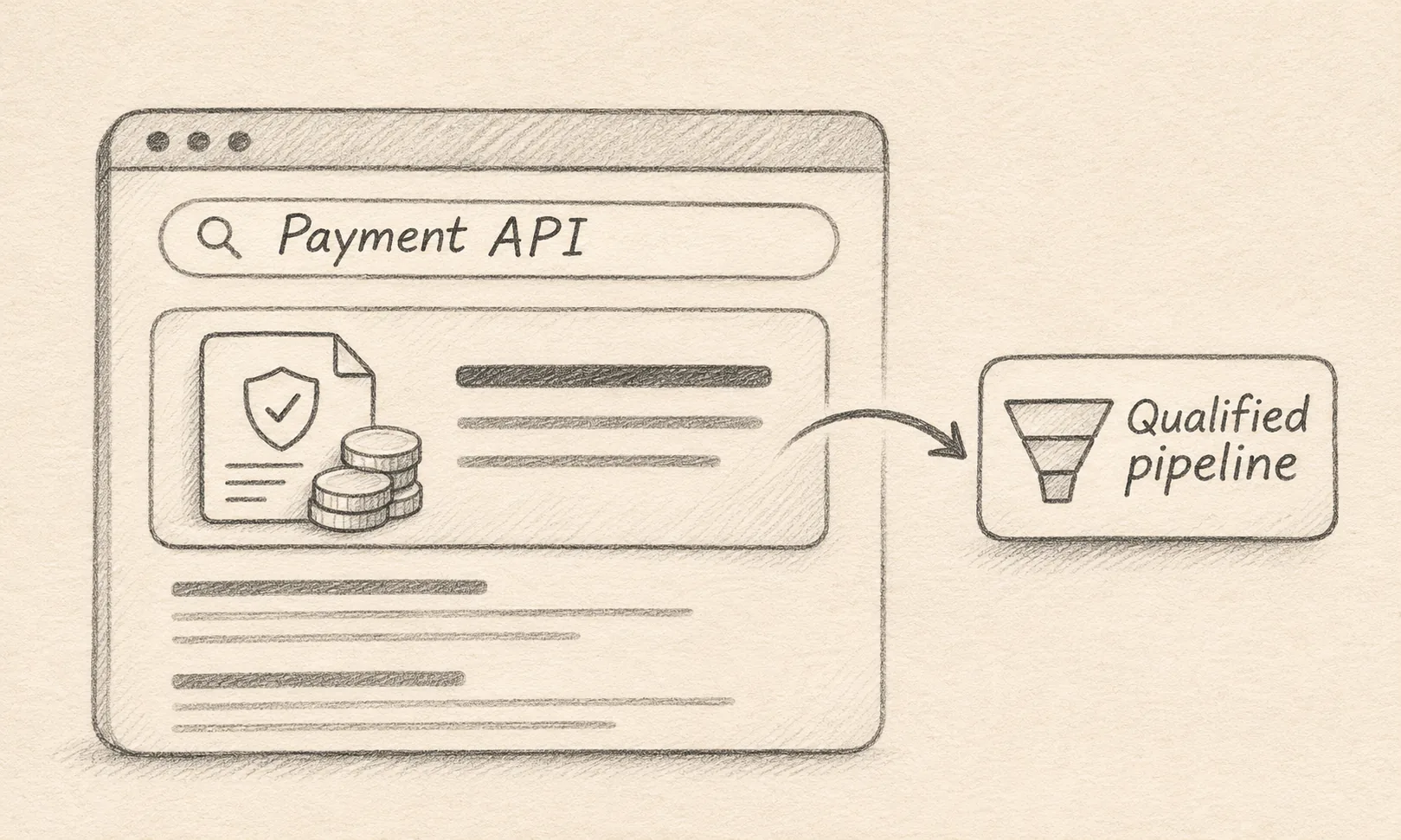
The playbook in short: start with the pages closest to a purchase (product, integration, comparison, pricing), not the blog. Build a review workflow so compliance speeds publishing up instead of blocking it. Keep docs, security pages, and pricing public and crawlable. Earn links from finance press, partners, and original data. And make your pages easy for AI assistants to quote, because a growing share of buyers now start their research there.
Measure it in qualified pipeline, not traffic. Expect early movement in three to six months and real pipeline impact in six to twelve.
What Is Fintech SEO?
Fintech SEO is the work of getting a financial technology company found in search engines and AI answers by the people most likely to buy. For a B2B fintech, that means finance leaders, operations teams, developers, and procurement, not consumers comparing savings accounts.
That distinction changes almost everything. A consumer fintech chases high-volume queries like “best business bank account.” A B2B fintech selling payouts infrastructure, spend management, or treasury software usually lives on small, specific queries. Think “same-day ACH API,” “NetSuite AP automation,” or “Ramp alternatives.” Those queries might get a few hundred searches a month. But one of them can be worth more than ten thousand visits from people who were never going to buy.
B2B fintech also has more people in the room. The CFO cares about cost and risk. The controller cares about the integration with your ERP. The engineer cares about your API docs. The security team wants your SOC 2 report. Good fintech SEO gives each of them a page that answers their question.
Why Fintech SEO Is Harder: YMYL and E-E-A-T
Google’s Search Quality Rater Guidelines put financial topics in the “Your Money or Your Life” (YMYL) category. These are topics where bad information can do real harm, so Google wants stronger evidence that a page is trustworthy.
That evidence is usually described as E-E-A-T: experience, expertise, authoritativeness, and trust. Google has said E-E-A-T isn’t a single ranking factor. But its systems do give more weight to these signals on financial topics. And of the four, trust matters most.
In practice, trust on a fintech site looks like this:
- A clear company identity: your legal entity name, address, and any registration or license numbers, kept consistent everywhere they appear.
- Named authors and reviewers: real people with relevant credentials, shown on the page, not only on a separate bio page.
- Dated content: visible published and last-reviewed dates, especially on pages about fees, limits, or rules.
- Sourced claims: every number linked to a primary source, such as a regulator, a scheme rulebook, or your own documented data.
- A public trust center: security, compliance, and data-handling pages that a buyer (or a crawler) can read without logging in.
Here’s the useful part. Almost everything on that list is also what your compliance team already wants. Good fintech SEO and good compliance pull in the same direction far more often than people assume.
How B2B Fintech Buyers Search in 2026
Search behavior has shifted fast in the last two years, and fintech buyers are no exception.
G2’s research from March 2026 found that 51% of B2B software buyers now start their research with an AI chatbot more often than with Google, although 80% still use Google at some point. Forrester puts AI use during the buying process at 94% of business buyers.
At the same time, ranking on page one no longer guarantees that you’re the source AI answers draw on. Ahrefs found that the share of Google AI Overview citations coming from top-10 results fell from about 76% in July 2025 to under 38% by January 2026. And when an AI summary appears, people click traditional results less. Pew Research found clicks dropped from 15% to 8% of visits when a summary was shown.
Two things follow. First, you need to show up in AI answers as well as in rankings. Second, the pages that get you there are the same ones that convert: specific, factual, well-structured pages about your product, pricing, integrations, and security. Vague thought leadership is easy for AI to summarize without ever citing you.
Building Your Fintech SEO Strategy
A fintech SEO strategy doesn’t start with a keyword tool. It starts with your sales team.
For the wider channel plan, our B2B fintech marketing strategy connects SEO with positioning, compliance, paid acquisition and lifecycle marketing.
Ask them three questions. Who signs the contract? What do prospects ask on the first call? Which competitors come up in deals? The answers tell you which buyers to target, what language they use, and which comparison pages you’ll need. Then go to the data.
Map Keywords to the Buying Journey
B2B fintech buyers move through a fairly predictable path. Each stage has its own kind of query and needs its own kind of page.
- Problem-aware: “why do ACH payments get returned,” “how to reduce payment failure rates.” Best served by explainers and reference pages.
- Solution-aware: “accounts payable automation software,” “embedded payments platform.” Best served by product and use-case pages.
- Evaluating vendors: “best spend management for startups,” “Brex vs Ramp,” “Stripe alternatives.” Best served by comparison and alternatives pages.
- Ready to buy: “[your brand] pricing,” “[your brand] NetSuite integration,” “[your brand] SOC 2.” Best served by pricing, integration, and trust pages.
For keyword ideas beyond the obvious, look at queries where you already rank in positions 5 to 20 in Google Search Console and Bing Webmaster Tools. Mine sales call notes and support tickets. And ask ChatGPT and Perplexity the questions your buyers would ask, then note which companies get mentioned.
One more tip. If your product category is so new that nobody searches for it by name, target the problem instead. People might not search for “payout orchestration,” but they definitely search for why their payouts keep failing.
Start at the Bottom of the Funnel
Most fintech companies start SEO by launching a blog. We think that’s backwards.
The pages that turn searches into demos are product pages, integration pages, comparisons, and pricing. They target fewer searches, but those searches come from people who are already shopping. Get those live, indexed, and strong before you publish your fiftieth blog post. A blog still matters for building authority and assisting conversions, especially for newer brands. It just shouldn’t come first.
The Page Types That Win in Fintech
Product and use-case pages. One page per product and one per major use case or industry. Be specific about who it’s for, what it does, and what it connects to.
Integration pages. Finance buyers care deeply about whether you work with their ERP, accounting system, or payroll tool. A dedicated page for each important integration, with a walkthrough of how it works, ranks well and answers the controller’s question. Brex’s NetSuite integration page and BILL’s integrations directory are good models to study.
Comparison and alternatives pages. “You vs competitor” and “competitor alternatives” pages capture buyers at their most decisive. In fintech they also carry the most risk, so keep them fair, factual, dated, and backed by sources. Wise built a lot of organic visibility with comparison pages against banks and money transfer services.
Pricing pages. Publish your pricing if you can. Even if you can’t publish exact numbers, a page explaining how pricing works will rank for “[brand] pricing” and gives AI assistants something accurate to quote. Stripe’s pricing page, with clear headline rates, is the standard example.
Reference pages. Structured pages that explain things like ACH return codes, payment failure codes, or settlement times for each payment rail. These attract engineers and operations teams, earn links, and get cited by AI tools. Include a review date and link to the official source.
Developer documentation. For API-first fintechs, docs are a major search and evaluation channel. Keep them public, well-structured, and linked to pricing, status, and security pages.
Trust and security center. SOC 2, ISO 27001, PCI DSS, data residency, sub-processors. Publish these as HTML pages, not PDFs, so search engines and AI tools can read them.
Calculators and data reports. A fee calculator or an annual report built on your own anonymized data rarely drives demos directly. What it does well is earn backlinks and press, which lifts everything else.
A Compliance-Friendly Content Workflow
In most fintechs, compliance review is the biggest bottleneck in content. A page sits in review for three weeks, then comes back with half the claims removed. The fix isn’t to avoid compliance. It’s to build a workflow that makes review fast.
Create a claims library. Write down the claims you make often (speed, coverage, security, fees, integrations) in pre-approved wording, with the evidence behind each one. Writers pull from the library instead of inventing new phrasing that needs fresh approval.
Tier your reviews. Not every page carries the same risk. A sensible split:
- Tier 1: pages with regulatory or financial claims, such as product, pricing, comparison, and regulatory status pages. Full pre-approval.
- Tier 2: templated pages, like integration or programmatic pages. Approve the template once, then spot-check new instances.
- Tier 3: editorial content like explainers. Periodic sampling, with escalation if a piece drifts into advice.
State conditions next to claims. If coverage depends on eligibility, say so in the same sentence, including in headings and meta descriptions. Keep disclosures in the copy, not hidden behind links.
Know which rules apply to you. Depending on your market and license, your content may fall under the FCA’s financial promotion rules and Consumer Duty in the UK, or the SEC Marketing Rule, FINRA Rule 2210, CFPB rules, or the FTC Act in the US. Be careful with security claims too. PCI DSS, SOC 2, and ISO 27001 each cover specific things, and overstating them is a compliance problem as well as a trust problem. Check the details with your compliance team; this guide isn’t legal advice.
Technical SEO for Fintech Sites
Fintech sites tend to break in a few predictable ways. Check these first.
Keep marketing pages server-rendered. Many fintech sites are built on JavaScript frameworks. Google can render JavaScript, but many AI crawlers can’t. Make sure product, pricing, comparison, and docs pages deliver their content in the HTML.
Check your firewall. Fintechs often run aggressive bot protection through Cloudflare or similar tools. That’s sensible, but it sometimes blocks Googlebot, Bingbot, or AI crawlers like OAI-SearchBot and PerplexityBot from your public pages. Test it.
Separate the app from the site. Your logged-in app, onboarding flows, and account pages should stay out of the index. Your public product pages, docs, and trust center should be fully crawlable.
Watch your scripts. Chat widgets, analytics, identity verification, and fraud tools add up. Too many third-party scripts slow pages down and hurt Core Web Vitals.
Handle multiple markets properly. If you serve the UK and US with different products or rules, use separate URLs with hreflang tags and a country switcher. Avoid automatic geo-redirects, which can stop search engines from seeing all your versions.
Use structured data where it fits. Organization, Article, BreadcrumbList, and SoftwareApplication schema help search engines understand your site. Google has said AI features don’t require any special markup, so schema is a support act, not a shortcut.
Fix your site structure. Fintech sites accumulate pages fast: campaigns, regional variants, old product names. Make sure every important page is linked from somewhere sensible. Our free Internal Link Visualizer shows how your pages connect, and the Content Duplication Checker flags pages competing with each other.
Building Authority and Links in Fintech
Links in fintech are hard to earn, and the wrong ones can hurt. A generic guest post on a marketing blog does little for a payments company. Relevance matters more than domain rating.
What works:
- Original data. Reports built on your own anonymized transaction or customer data. Journalists and analysts cite numbers they can’t get anywhere else.
- Expert commentary. Fast, quotable responses to regulatory changes and industry news. Finance and tech press need expert voices.
- Partner ecosystems. Listings and co-marketing with the platforms you integrate with, such as accounting, ERP, banking, and payments partners.
- Industry recognition. Awards, association memberships, analyst coverage, and conference talks.
- Founder and executive visibility. Podcasts, panels, and bylined articles in finance publications.
- Review platforms. Up-to-date, well-reviewed profiles on G2 and Capterra, which also show up in AI answers.
Skip paid links, link exchanges, and content farms. In a YMYL category, the risk isn’t worth it.
Getting Cited in AI Search
Generative engine optimization (GEO) is about getting your company mentioned and cited when buyers ask ChatGPT, Perplexity, Gemini, Claude, or Google’s AI Overviews about your category. In our view, SEO and GEO aren’t separate disciplines. GEO builds on good SEO, with a few extra habits.
- Let AI crawlers in. Check that robots.txt and your firewall allow Bingbot (which powers Copilot), OAI-SearchBot, and PerplexityBot on public pages.
- Write in quotable passages. Open each section with a clear, self-contained answer that names specific facts. AI tools quote passages, not whole pages.
- Use tables for facts. Fees, limits, supported countries, and feature comparisons are easier for AI to extract from a table than from paragraphs.
- Get listed where AI looks. AI answers draw heavily on third-party “best of” lists, review sites, and directories. Make sure your information there is accurate and current.
- Test a fixed set of prompts. Write down the 20 to 30 questions your buyers ask. Run them monthly across AI tools. Note whether you appear, what’s said about you, and which sources get cited.
A note on llms.txt: several API-first fintechs publish one, but Google has said it doesn’t use llms.txt for Search. Treat it as a developer convenience, not a ranking lever. Our GEO service covers this whole area alongside SEO.
How to Measure Fintech SEO
Traffic is the wrong headline number for a B2B fintech. You could double traffic with educational content and add zero pipeline. Measure in layers instead:
- Buyer-intent visibility: rankings and clicks for product, integration, comparison, and pricing queries. Track non-branded clicks separately from branded.
- AI visibility: how often you appear for your fixed prompt set, and referral traffic from chatgpt.com, perplexity.ai, and copilot.microsoft.com.
- Brand demand: growth in branded search and direct traffic, which often rises when AI tools mention you without a click.
- Pipeline: demo requests, qualified opportunities, and pipeline value from organic, tracked in your CRM.
Agree with sales upfront on what counts as a qualified lead. Attribution will never be perfect, especially with AI in the mix. Adding a “How did you hear about us?” field to your demo form helps fill the gaps. Our analytics team builds dashboards that connect these layers to CRM pipeline.
Common Fintech SEO Mistakes
Leading with the blog. Fifty thought-leadership posts and no integration pages. It’s the most common pattern we see.
Hiding everything behind a login or a PDF. If your security documentation, pricing, and docs aren’t public HTML, search engines and AI tools can’t use them.
Thin programmatic pages. Generating hundreds of pages that only swap an industry or city name breaks Google’s scaled content abuse policy. Programmatic pages work only when each one carries data that’s specific to it, like live rates or scheme rules.
Content written without an expert. A generalist writer can draft. But a person who knows payments, lending, or treasury needs to review, and their name should be on the page.
Letting pages go stale. Fees change, rules change, products change. Review high-risk pages every three to six months, and immediately after any regulatory or pricing change.
Treating compliance as the enemy. Bring them in early with a claims library and tiered reviews, and they’ll speed you up.
Timelines and Costs
How long does fintech SEO take? Most guides land on similar ranges, and they match what we see. Expect early ranking movement within three to six months, and meaningful growth in qualified pipeline within six to twelve. Highly competitive commercial terms can take 12 to 18 months, especially for a newer domain.
Costs vary with how much you need done. As a rough guide from published agency pricing:
- Early-stage fintechs: about $2,000 to $4,000 a month for focused technical and content work.
- Growing fintechs in competitive categories: about $4,000 to $8,000+ a month.
- Enterprise programs: $10,000 a month and up.
Budget for subject-matter review time on your side, too. It’s the cost most teams forget.
Choosing a Fintech SEO Agency
You can run fintech SEO in-house if you have a strong SEO lead, writers, and access to experts. Many teams don’t, and an agency that already understands YMYL content, compliance workflows, and B2B buying can save you a year of learning.
EverClif
EverClif is an AI-driven demand generation agency built for three industries: B2B SaaS, IT services, and FinTech. Our founder, Anirban Saha, spent close to two decades in marketing and technology, including building B2B demand generation pipelines at American Express and Goldman Sachs. So the realities of financial services (compliance reviews, long sales cycles, buying committees) aren’t new to us.
Our SEO program is judged on qualified leads, not rankings. AI workflows, checked by a human, surface about four times more business-relevant search intent than standard keyword research. The same team handles technical fixes, content, authority building, and GEO, and can build or rebuild your website when the structure needs it. For a US vertical SaaS company launching on a one-month-old site, that approach grew organic users 8.3x in a quarter. For a FinTech client in Germany and France, our paid campaigns grew qualified leads 200% in the first quarter.
- Best for: B2B fintechs that want SEO, GEO, and analytics run as one program tied to pipeline.
- How we start: a free domain audit and growth forecast, with no commitment.
What to Look For in Any Agency
- Experience with YMYL content and a clear process for working with your compliance team.
- A plan that starts with product, integration, comparison, and pricing pages, not a blog calendar.
- Technical depth: rendering, crawl access, international setup, and site structure.
- A defined approach to AI search visibility.
- Reporting tied to pipeline in your CRM, not just traffic and rankings.
- Honest timelines. Anyone promising first-page fintech rankings in 60 days is guessing.
Final Thoughts
The fintechs that win in search over the next few years won’t be the ones that publish the most. They’ll be the ones whose public pages are the most specific and the most trustworthy. Clear pricing. Accurate integration details. Real security documentation. Named experts. Dated facts.
That’s exactly the material that ranks in Google, gets cited by AI assistants, and convinces a skeptical CFO. If you want help building it, book a free audit and we’ll show you where to start.
In fintech, the most trustworthy page usually wins the search.